Presentation and Discussion of the First Draft of New State Building Code (DBN) "Tram and Trolleybus Lines" Held
On October 14, 2026, a public presentation and discussion of the first draft of the new State Building Code (DBN V.2.3-18:20XX) "Transport Facilities. Tram and Trolleybus Lines. General Design Requirements" took place.
The text of the first edition of the updated standards was developed over the summer and autumn of 2026 by the State Enterprise "Scientific-Research and Design-Technological Institute of Municipal Economy" (SE "NDKTI MG") commissioned by the NGO "Vision Zero".
Representatives of municipal electric transport operators in Ukraine, local government bodies related to electric transport infrastructure, engineers, design organizations, NGOs, as well as manufacturers of rolling stock, special components, and assemblies were invited to the presentation and discussion.
A total of 24 people joined the meeting: alongside representatives of NGO "Vision Zero" and SE "NDKTI MG", who presented the new DBN text and explained its scope, attendees included representatives from:
- The Ministry for Restoration, Infrastructure and Transport of Ukraine — specifically Sviatoslav Tovstyha (Head of the Urban Transport Department, Internal Road Transport Management) and Tetiana Navrotska (Chief Specialist, Internal Road Transport Management).
- Municipal Companies — operators of public electric transport systems from Lviv, Dnipro, Odesa, Mykolaiv, Kryvyi Rih, Poltava, Khmelnytskyi, Ivano-Frankivsk, and other cities.
- Relevant structural units of city councils dealing with the development and operation of electric transport infrastructure.
- NGOs and design-consulting bureaus related to the transport sector.
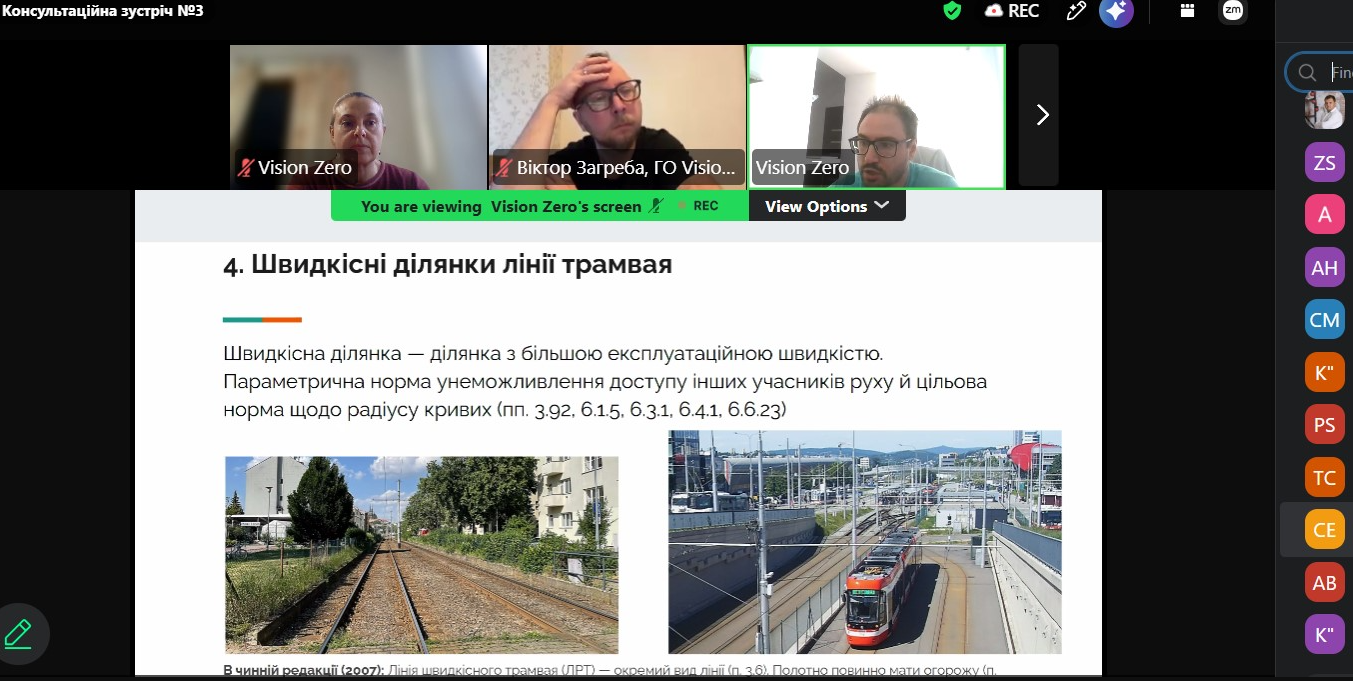
The proposed changes to the DBN "Tram and Trolleybus Lines" were presented by Viktor Zagreba (Head of the NGO) and Yuriy Lozovenko (transport planning and urban mobility specialist) on behalf of NGO "Vision Zero", and by Volodymyr Kryvulia (Chief Specialist in Electric Transport Infrastructure) on behalf of the Scientific-Research and Design-Technological Institute.
The presentation of the draft new DBN V.2.3-18 highlighted key changes in approaches to designing urban electric transport infrastructure that directly impact the sector's development and its alignment with European standards. The priority of parametric and performance-based methods over prescriptive regulation was emphasized in accordance with current legislation, mentioning the reduction of excessive requirements and restrictions by converting them into recommendations or replacing them with a parametric approach, replacing tables of fixed technical parameter values with requirements for specific physical-technical properties or safety factors, etc. It was separately noted that references to obsolete Soviet and Russian GOSTs and SNiPs were completely removed and replaced with references to current national regulatory documents and, most importantly, Eurocodes (DSTU EN, DSTU ISO, DSTU EN ISO).
The presentation highlighted the main technical changes regarding the construction of tram tracks:
- reduced distances to buildings (enabling layout on narrow streets) and structures,
- the possibility of placing tram tracks shared exclusively with public transport (such as trolleybuses) and in pedestrian zones (currently restricted only to major arterial streets and roads),
- distances between track axes or to outer rails replaced with safety clearances based on actual vehicle dimensions,
- reduced requirements for minimum curve radii without specifying the type of tram section (conventional or high-speed),
- replacing a high-speed "line" with a "section" — a single route can run through both conventional and high-speed sections,
- calculation of track geometric parameters (curve radii, transition curves, cants/superelevations, and corresponding speeds) according to European standard EN 13803 instead of Soviet-era tables with fixed values,
- individual design of tram switches and junctions according to spatial conditions — with the possibility of overlapping adjacent turnouts with fixed parts in tight conditions, and installing "drawn-out" switches,
- introduction of the standard gauge concept (1435 mm) as a tram track standard (one of the values of "normal gauge"),
- replacement of specific structural solutions for the track superstructure and pavement with physical-technical requirements.
The proposed changes to the requirements for the contact network and power supply permit shared tram-trolleybus traffic, including joint shared stops (due to smaller distances between overhead catenary wires), account for high-speed switches and other modern elements and special components of the overhead catenary to accelerate trolleybus traffic, and provide for the widespread use of sections and infrastructure for autonomous (off-wire) movement of trams and trolleybuses, which in particular allows trolleybus lines to cross electrified railway tracks at conventional level crossings (when grade-separated crossings are impossible in tight spaces or economically impractical).
Regarding urban electric transport stops, the draft DBN accounts for tolerances for different widths of tram cars, while prohibiting boarding/alighting directly from the roadway (mandating either raising the roadway area to platform height or installing island platforms). It also introduces a requirement for priority tram movement at traffic lights in a coordinated "green wave" mode, making the tram not only convenient and accessible, but also fast — more attractive for trips.
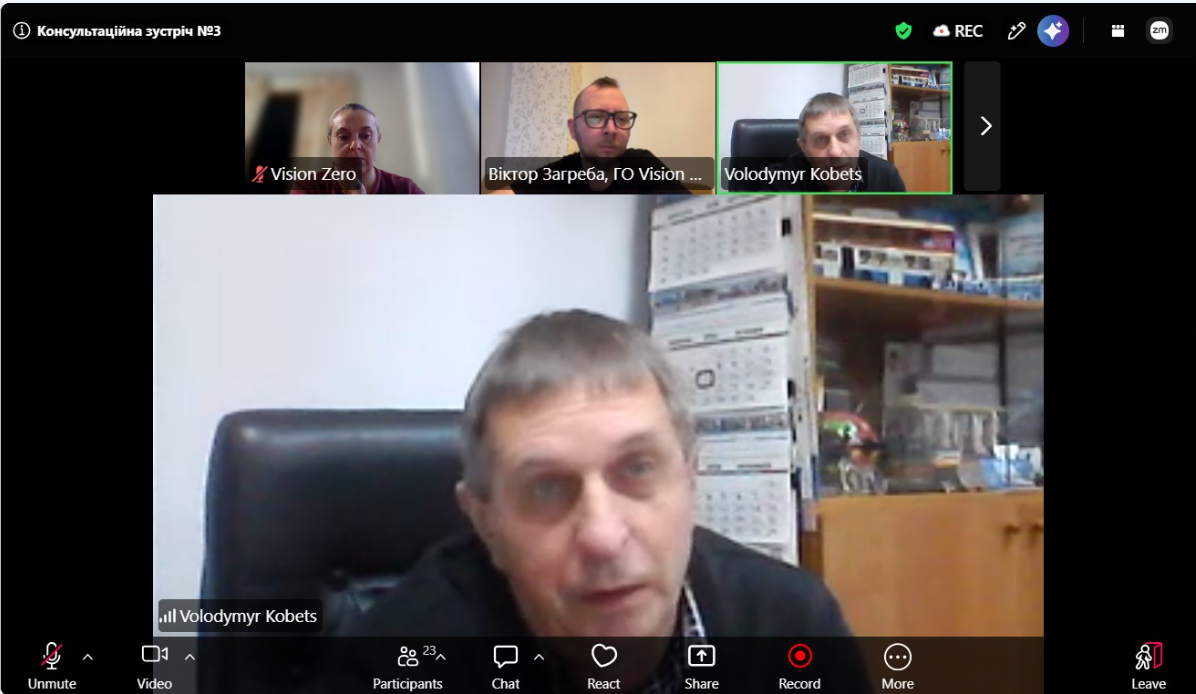
During the discussion of the presented draft DBN V.2.3-18, Sviatoslav Tovstyha spoke on behalf of the Ministry, and representatives of municipal electric transport enterprises of Dnipro, Mykolaiv, Lviv, as well as representatives of consulting bureaus and public organizations shared their views.
All attending stakeholders agreed to formulate their proposals and comments in writing and send them by the end of October 2026 for further processing and inclusion in the second draft of the DBN. Currently, proposals have been received from seven cities — Vinnytsia, Lviv, Dnipro, Mykolaiv, Odesa, Kryvyi Rih, and Kyiv, as well as from several independent experts.