Trolleybus infrastructure in the Czech Republic: report on a research trip
In the previous publication, we reviewed the tram infrastructure in the cities of the Czech Republic. Let's continue our review of electric transport in Prague and Brno: next is the trolleybus infrastructure.
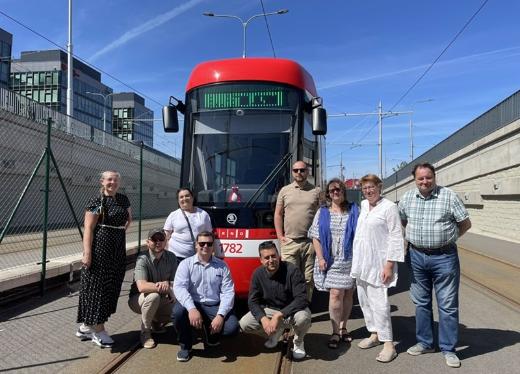
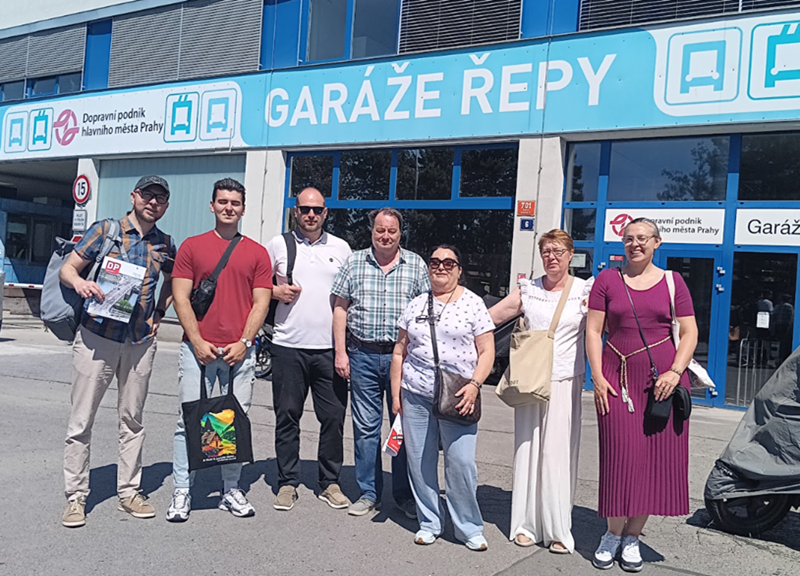
We would like to remind you that in May 2026, the NGO “Vision Zero” organized a study trip to the cities of the Czech Republic to study their experience in developing, equipping, and operating tram and trolleybus systems. The participants of this trip were managers and specialists of the State Enterprise “Scientific, Research, Design, and Technological Institute of Urban Economy”, representatives of the Ministry of Community and Territorial Development of Ukraine, and the State Service of Ukraine for Transport Safety.
In the cities of Prague, Brno and Pardubice, participants conducted field inspections of the infrastructure, assessed the operation of rolling stock on routes, visited depots and discussed the features of organizing transport services with local carriers.
Why Czech Republic?
The Czech Republic is a country of electric transport. With a population of about 11 million people, as many as 21 cities in the Czech Republic have trams or trolleybuses. For comparison, in Belgium, with about the same number of inhabitants, electric transport is much less developed and covers only 7 cities, and in all three Baltic countries (with a combined population of about 6 million people) only 5 cities have electric transport. In terms of its historical, economic and geographical context, this country is much closer to Ukraine than, for example, Switzerland, Italy or France, where tram and trolleybus systems also exist in large numbers. Therefore, it was the Czech Republic that was chosen for the research trip.
The cities of Prague (1.4 million people), Brno (400,000 people), Ostrava (290,000 people) and Pilsen (190,000 people) have both tram and trolleybus systems. This article focuses on the trolleybus networks of the two largest cities in the country, Prague and Brno.
Trolleybus system in Prague
The modern trolleybus network in the Czech capital is completely new - its first line was opened in 2017, 45 years after the trolleybus was closed in 1972. Its main difference is the massive use of battery-powered trolleybuses (with autonomous operation, namely: the IMC type - “in motion charging” - with charging while moving under the contact network).
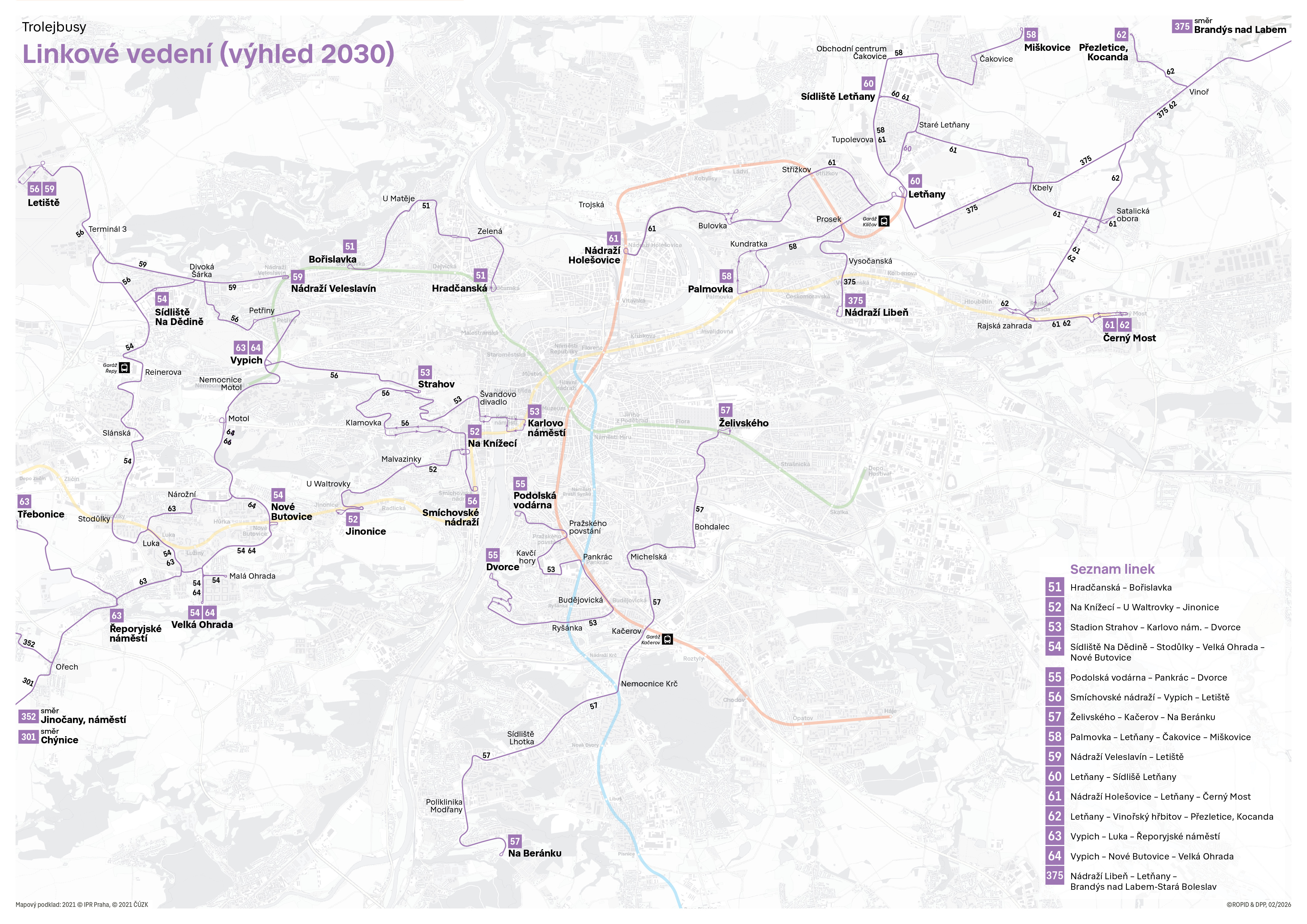
Prague's trolleybus network has had 2 separate lines since 2024, with 3 more routes scheduled to open in 2026. The plans include developing the network to 15 routes by 2030 , including one suburban route.
The trolleybus fleet at the beginning of 2026 consists of 35 articulated units , of which 20 are 3-section Škoda–Solaris trolleybuses (length 24 m). All trolleybuses are completely low-floor. The rolling stock is based in two bus depots, additionally equipped for trolleybus servicing - Řepy and Klíčov.
Trolleybus system in Brno
The Brno trolleybus network has a total length of almost 60 km (over 100 km of routes in total) and over 120 stops. The network has 13 routes, with an interval of 10-20 minutes , most of which run from 5 am to 10 pm.
The trolleybus fleet consists of almost 150 units of various models, all of which, except for 5 retro models, are accessible to people with reduced mobility. The rolling stock is based in 3 depots: Slatina, Husovice and Komín. The annual passenger traffic of the trolleybus network is over 46 million passengers .
Research trip results
The participants of the research trip carried out and documented field observations, comparing what they saw with the provisions of regulatory documents in the Czech Republic and Ukraine. Attention was focused on infrastructure: road infrastructure, contact networks, charging infrastructure, depots, stops, solutions for integrating trolleybuses into city streets and combining with other mobility modes.
Trolleybus lines in development
Ukrainian building codes contain certain restrictions and obstacles for designing trolleybus lines in existing urban development: DBN B.2.2-12 “Planning and development of territories” allows laying trolleybus lines exclusively on main streets, and on residential streets it is allowed only in large, major and largest cities - with appropriate justification and the presence of a comprehensive transport scheme. In addition, according to DBN B.2.3-18 “Tram and trolleybus lines”, the width of the carriageway for trolleybus traffic must be at least 7 m, which makes it impossible to lay trolleybus lines on streets with a carriageway of a smaller width.
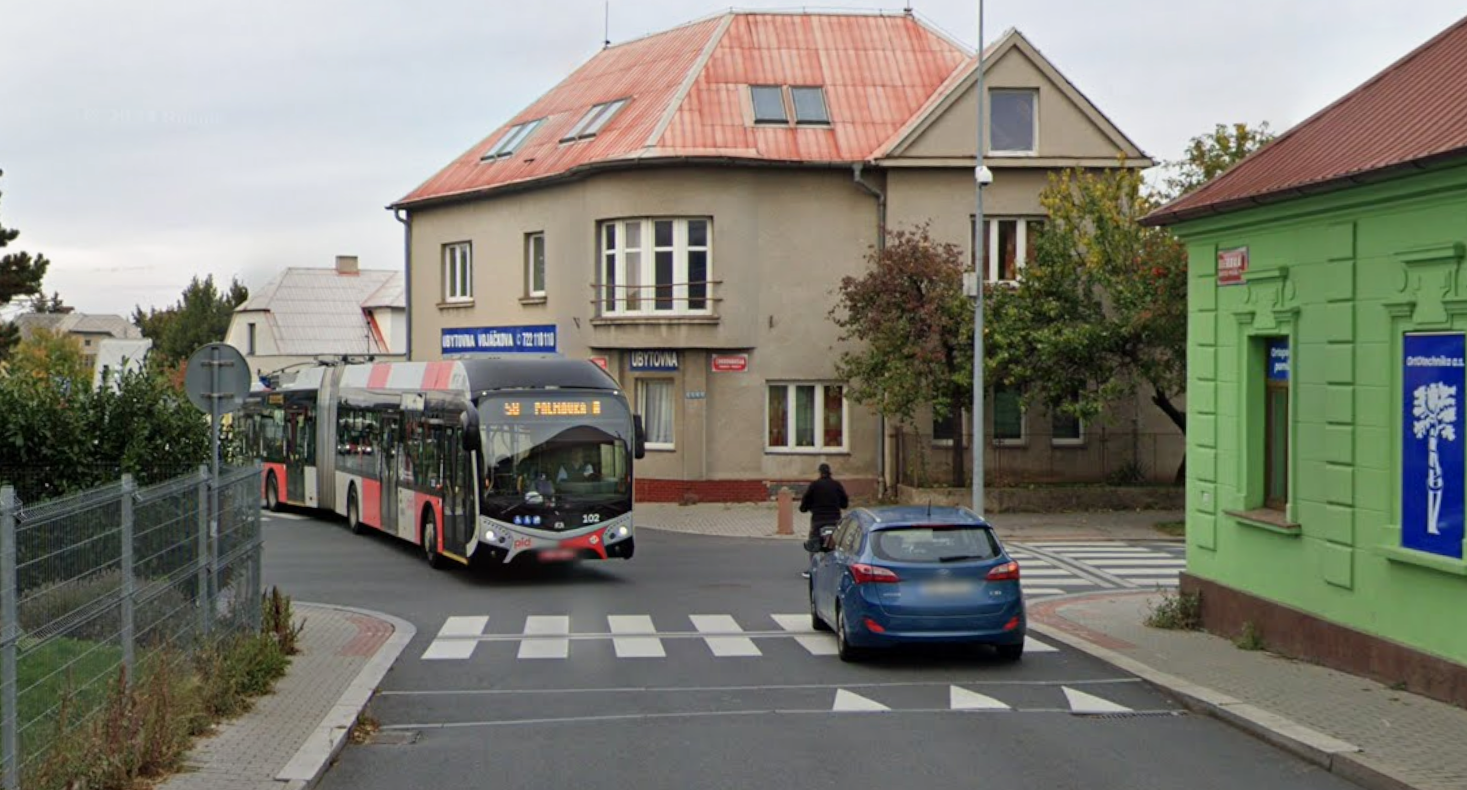 Prague: ul. Oderská. Trolleybus route 58 on an autonomous section passes an elevated intersection, heading along a residential street in the Čakovice district. Photo: Google Maps.
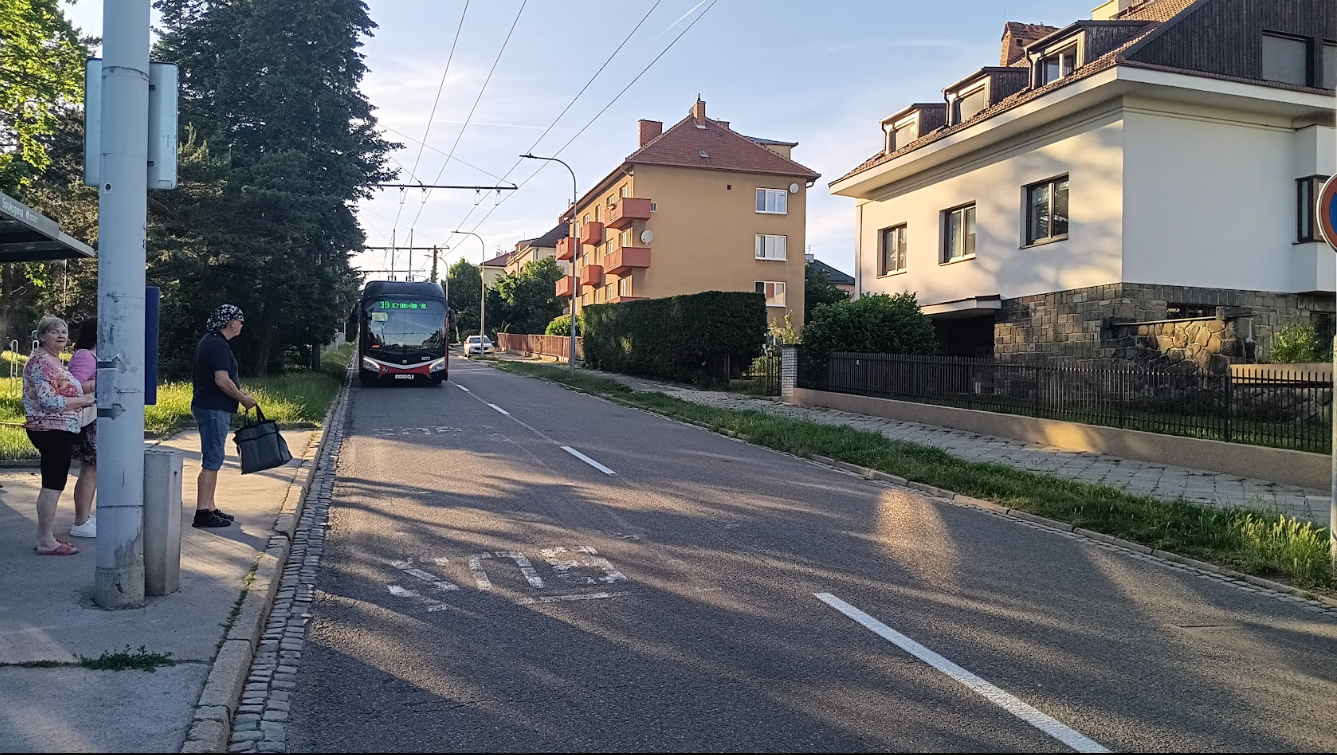 Brno: ul. Barvičova. Trolleybus traffic on a residential street. The width of the carriageway is 7 m.
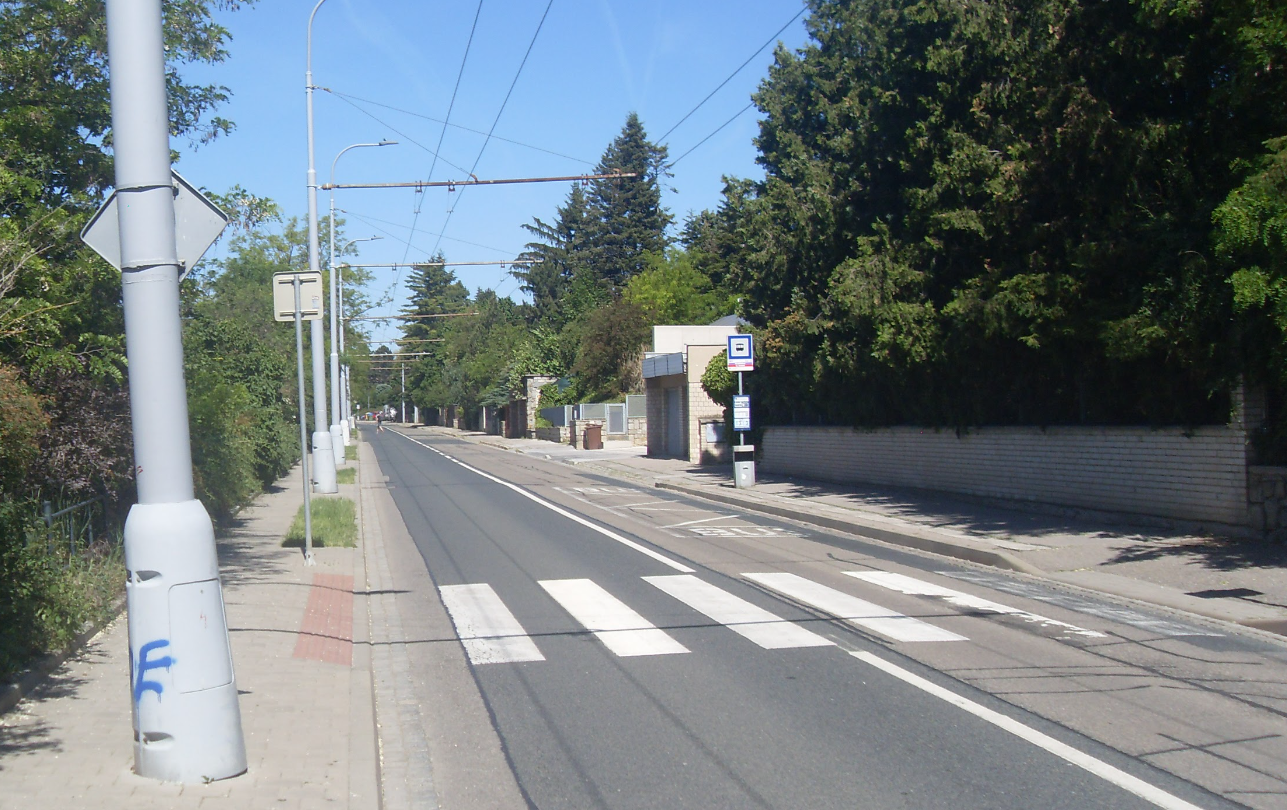 Brno: ul. Preslova. Trolleybus traffic on a residential street. The width of the carriageway is 6.2-6.5 m.
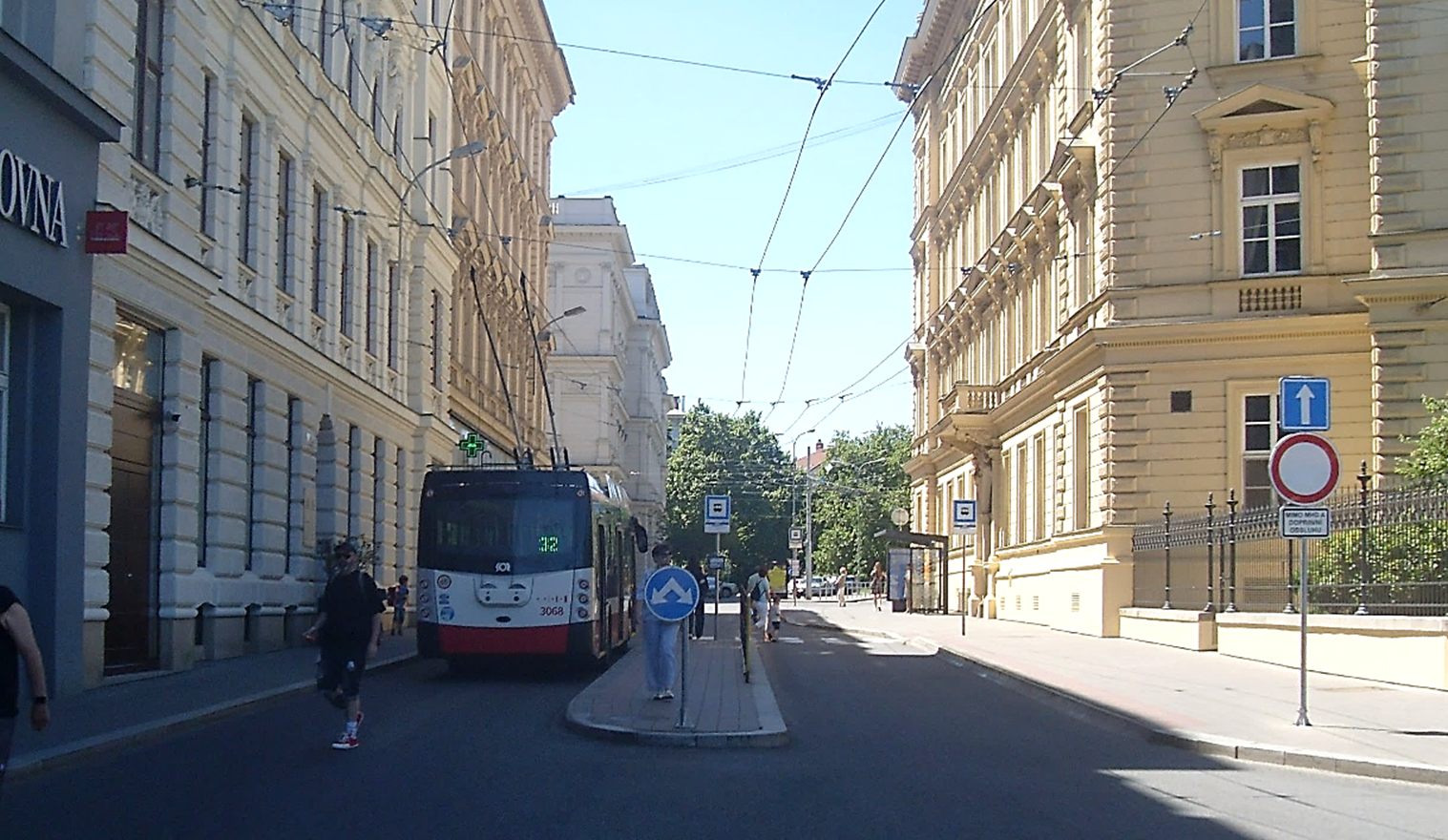 Brno: Trolleybus terminus in the historic center - Česká: 2 landing areas. The width of each passage is about 3 m. Car traffic is prohibited, pedestrians can cross the street freely.
As we can see, in the Czech Republic there are no restrictions on the categories of streets on which trolleybus services can be installed. If necessary, both main and residential streets are used equally, and even areas closed to motor vehicle traffic in the historic center. In this vein, we should also mention the city of Pardubice, where the trolleybus line runs simply through a pedestrian zone (at sidewalk level), and a single-lane road is provided for two-way traffic on this street (Třída Míru). In 2024, regular traffic was closed here (it had existed since 2014), but the reason for the closure was the lack of road surface design (the load from the trolleybus was not taken into account) and the desire to reduce the area of the paved surface on the street - to add more greenery.
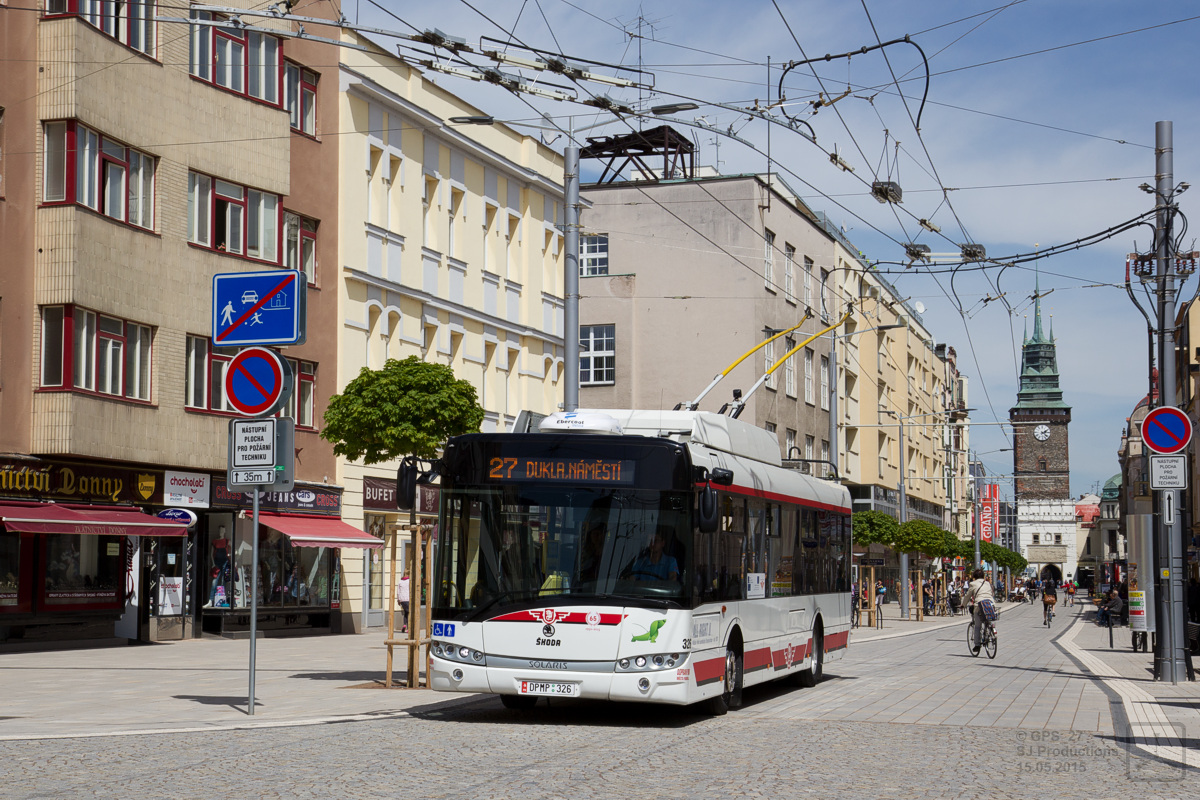 Pardubice: Třída Míru. Trolleybus route 27 in a pedestrian zone, having just passed a single-lane section with two-way trolleybus traffic. Photo: Alltransua.com.
Features of the catenary network
Ukrainian standards (DBN V.2.3-18 “Tram and trolleybus lines”) require a specific height for hanging the contact wire: not less than 4.7 m at the gates (passages) of buildings and not less than 4.2-4.4 m under engineering structures (usually overpasses). The standards also require a distance of not less than 3.5 m between the contact wires of adjacent tram and trolleybus lines or opposite directions of trolleybus lines. The practice of the Czech Republic has shown a more flexible approach focused on safety and functionality.
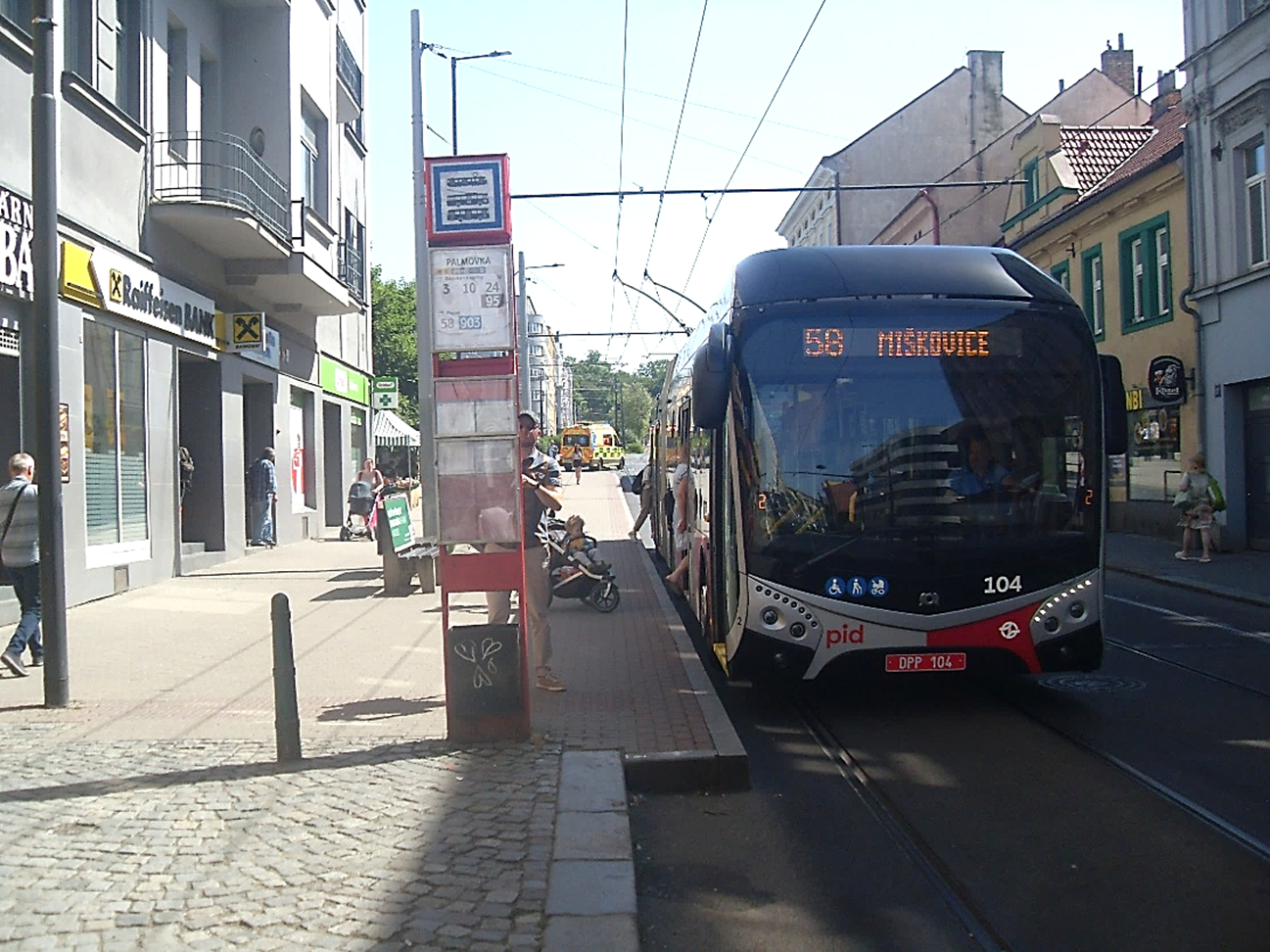 Prague: ul. Zenklova, combined stop Palmovka (tram, trolleybus, bus).
In Prague, in different districts, the research group observed shared lanes and shared stops for trams and trolleybuses, and the distance between the tram and trolleybus wires was 1.0-1.5 m (or even less). It is also clear that the trolleybus wires are located above the landing platform of the stop, which is prohibited in Ukraine. The landing platform of the stop has a protrusion into the carriageway - the trolleybus and tram drive up close.
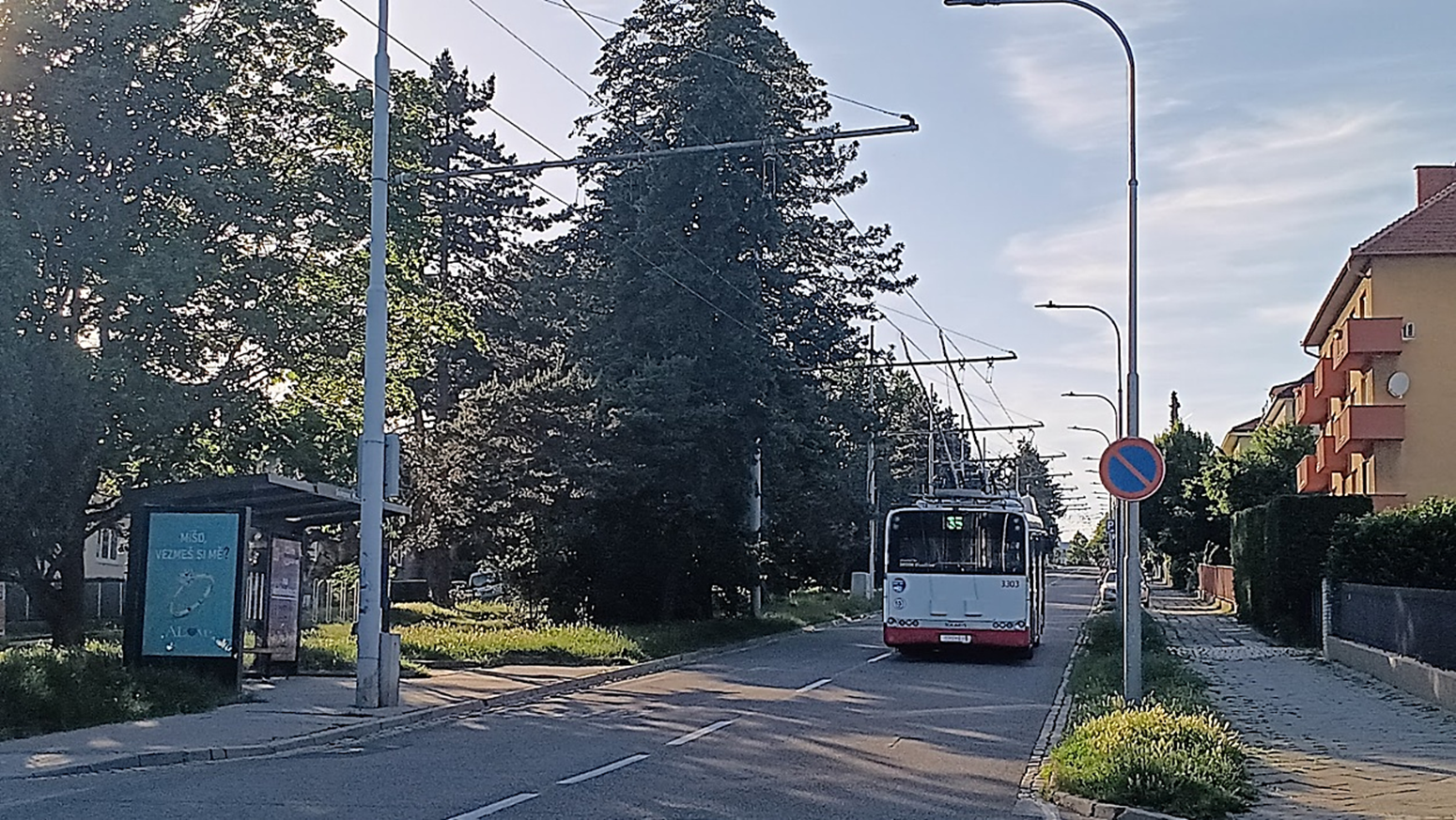 Brno: ul. Barvičova. The contact wires of both directions of traffic are suspended on brackets from poles on one side of the street. The distance between the contact wires of the opposite directions is less than 2 m.
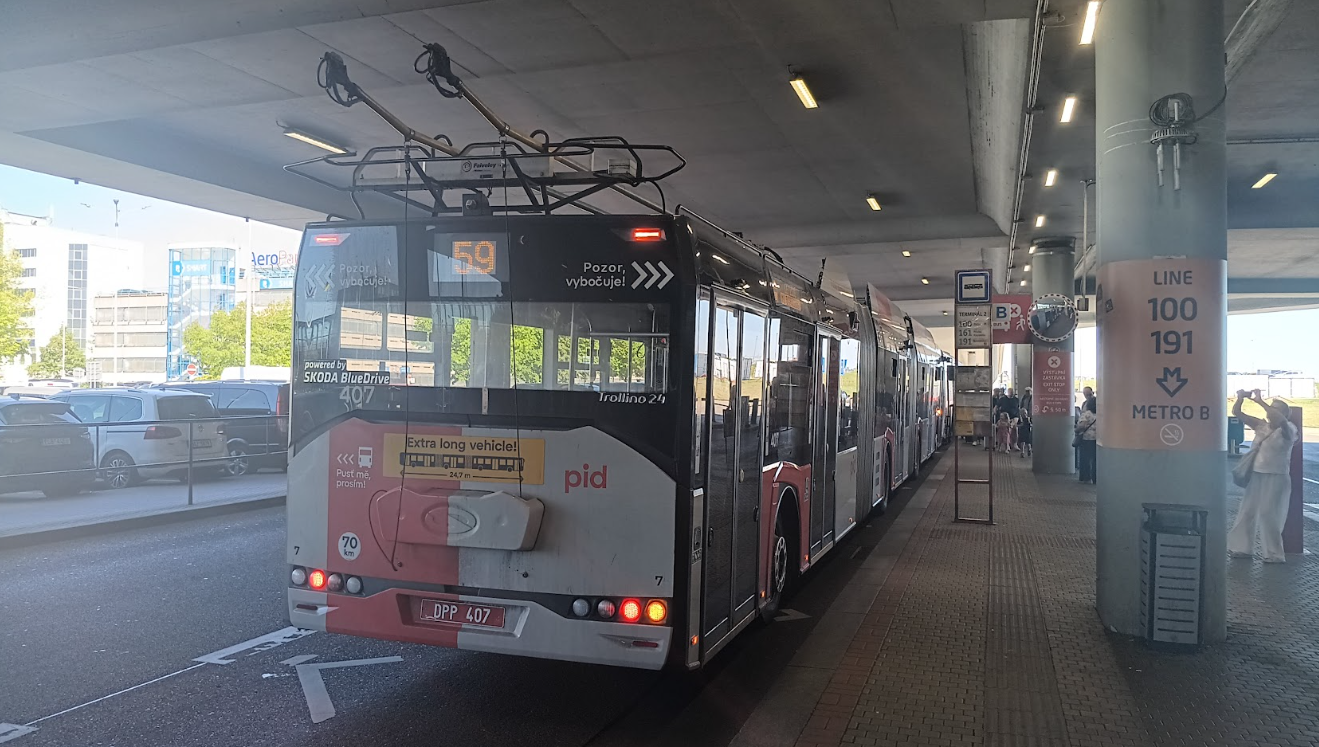 Prague: final stop of route 59 “V. Havel Airport. Terminal 2”.
The use of battery-powered trolleybuses allows you to pass through covered areas with a height of less than 4 m in the clearance.
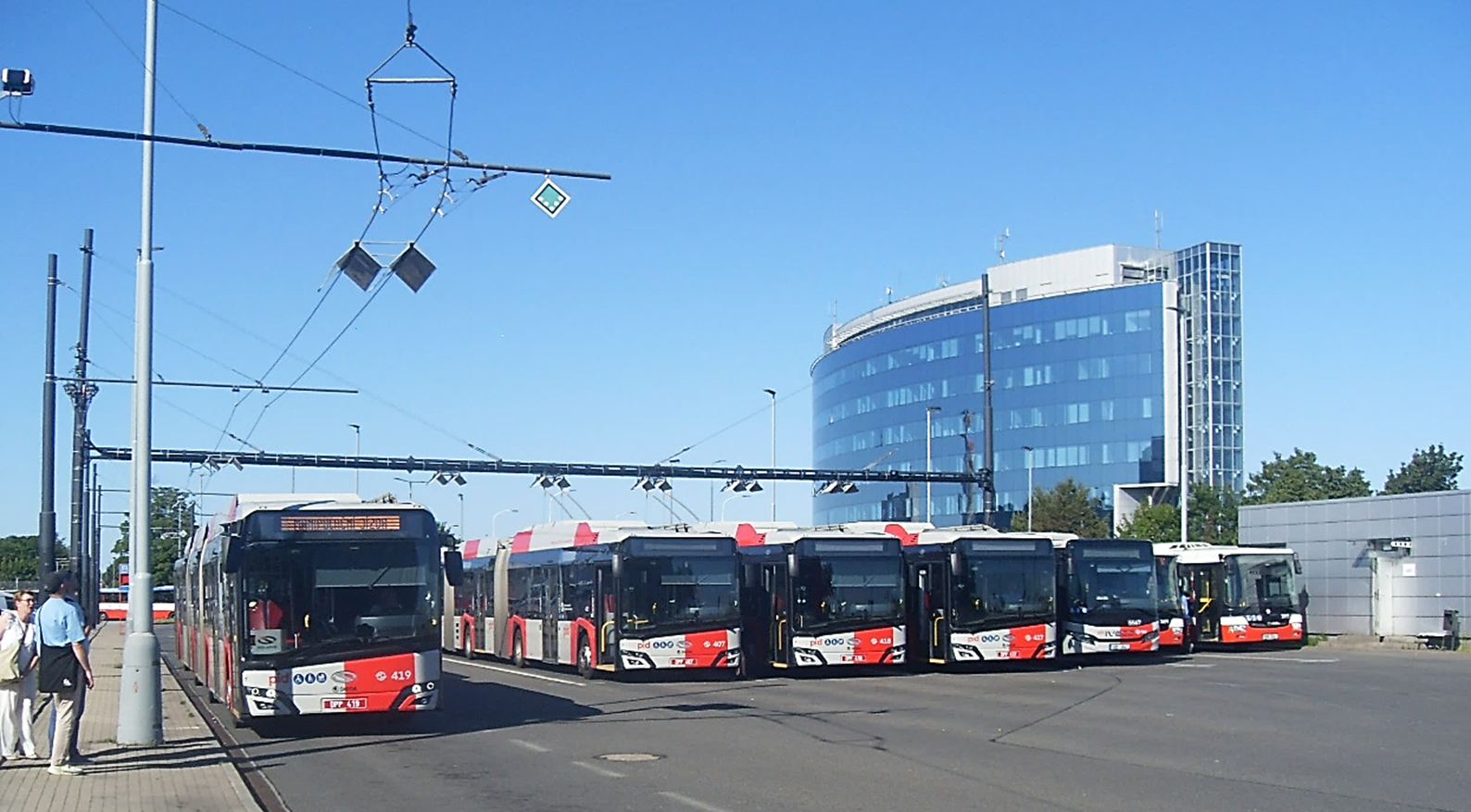 Prague: final stop of route 59 “V. Havel Airport”.
A large trolleybus and bus depot is used to recharge battery-powered trolleybuses. The design of the battery charging station allows for the simultaneous charging of several (6) trolleybuses.
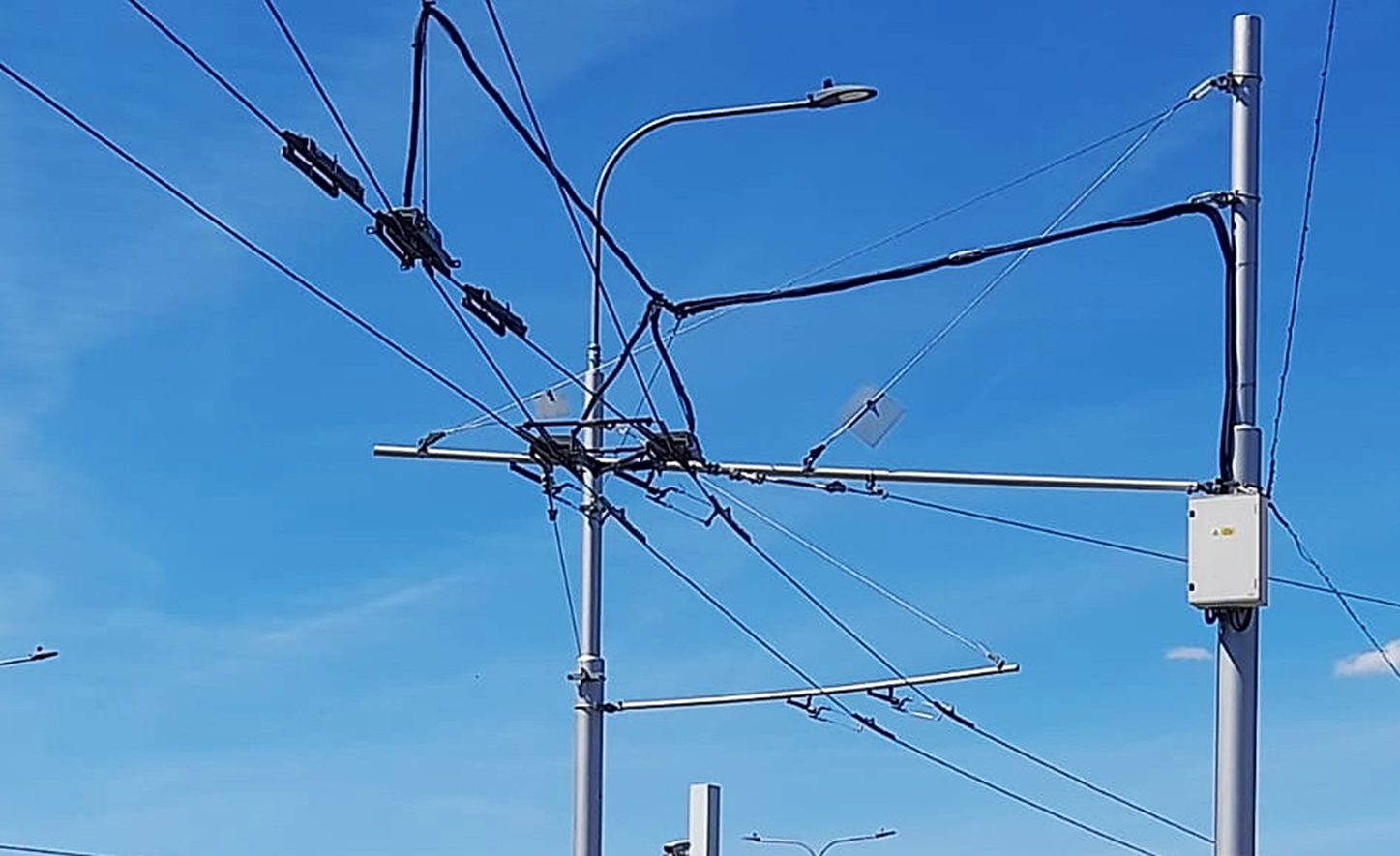 Brno: All trolleybus exit switches with remote switching and electronic control system. The switches are designed for trolleybus speeds of up to 50 km/h.
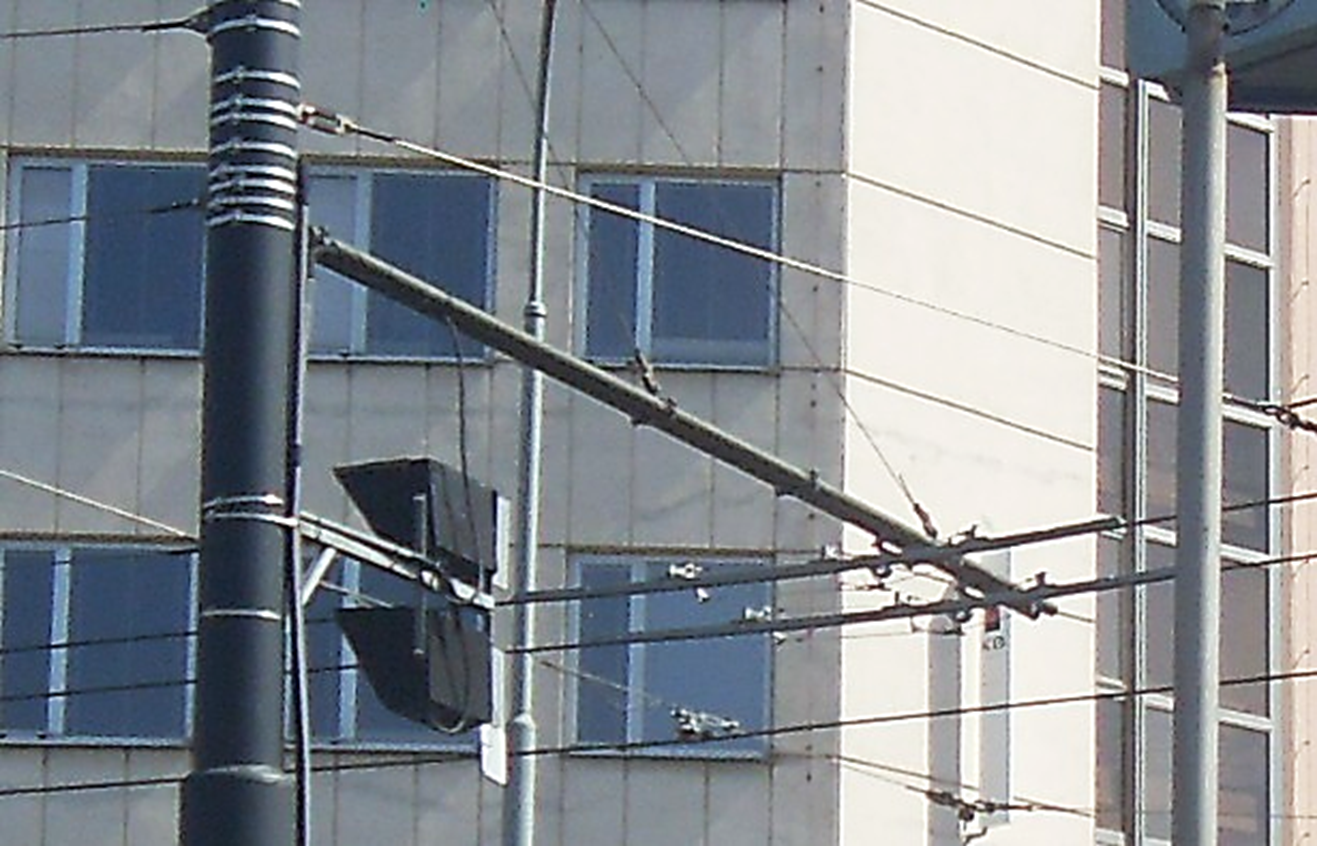 Brno: In many cases, the pulling and fixing of trolleybus wires on curves is carried out not with the help of stretchers, but on brackets fixed to the supports, which gives a clearer geometry and position of the contact wire in space and allows faster passage of curves, without the risk of “rod breakage”.
As we can see, in the Czech Republic there are no restrictions on the placement of the contact network above pedestrian zones, and the distances between the contact wires of trams and trolleybuses, or oncoming trolleybus directions, are very small: within 1-2 m under cramped conditions. At the same time, solutions for accelerating the passage of trolleybuses in turns and on switches are widely used, and in other cases (including with limited height dimensions) autonomous movement of trolleybuses is widely used, which demonstrates the same flexibility of solutions.
Organization of stops
Ukrainian standards ( DBN V.2.3-5 “Streets and roads of settlements”, DBN V.2.3-18 “Tram and trolleybus lines”) provide for the placement of trolleybus stops, as a rule, spaced apart (after crossings and at a distance from intersections, separately for trams and trolleybuses). Landing areas should be at least 1.5 m wide, but stops often have entry pockets that take up the entire sidewalk space (passage and boarding and disembarking at the narrowest point of the sidewalk). Stops should be located only on straight sections with a slope of up to 6%. A survey of stops in the Czech Republic revealed many differences.
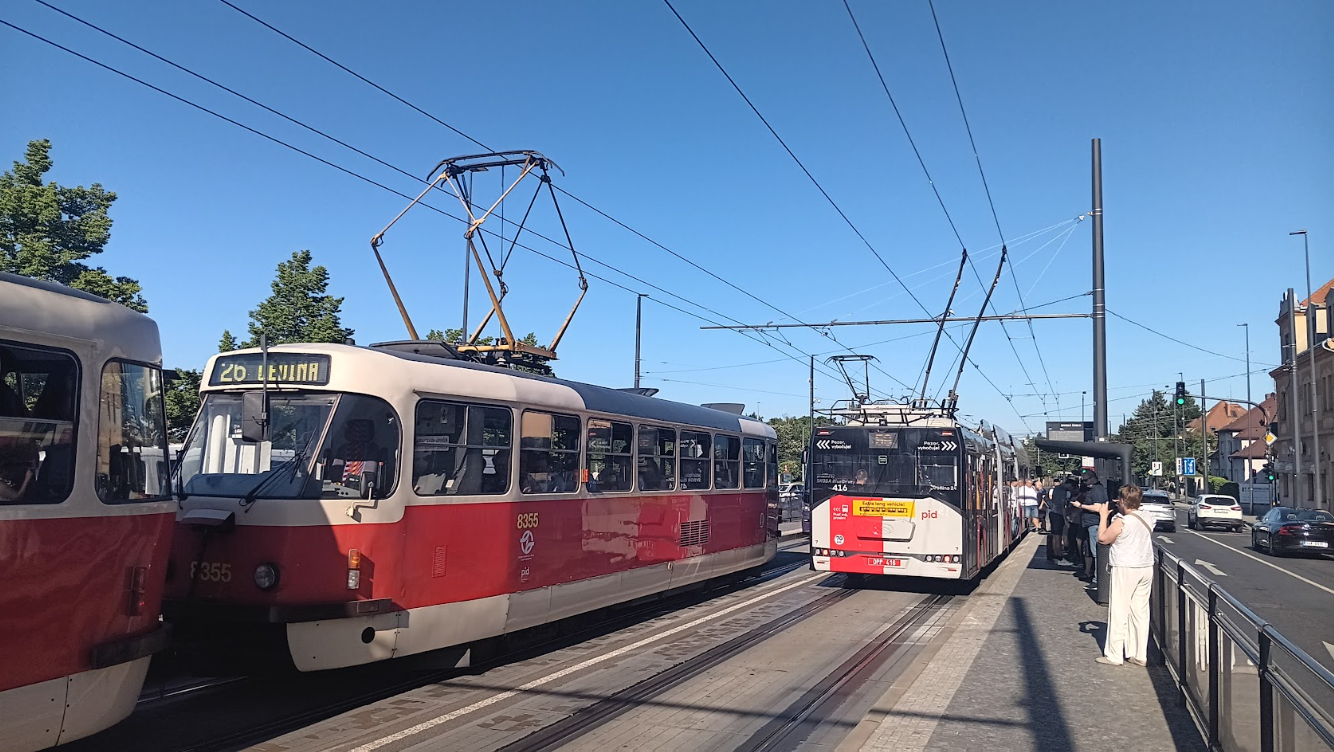 Prague: ul. Evropská, stop Dívoká Šárka - a combined stop for trolleybuses and trams. The height of the landing platform is 20 cm (common for all types of transport), the width of each lane is about 3 m, which forces the trolleybus to drive up close to the curb of the stop.
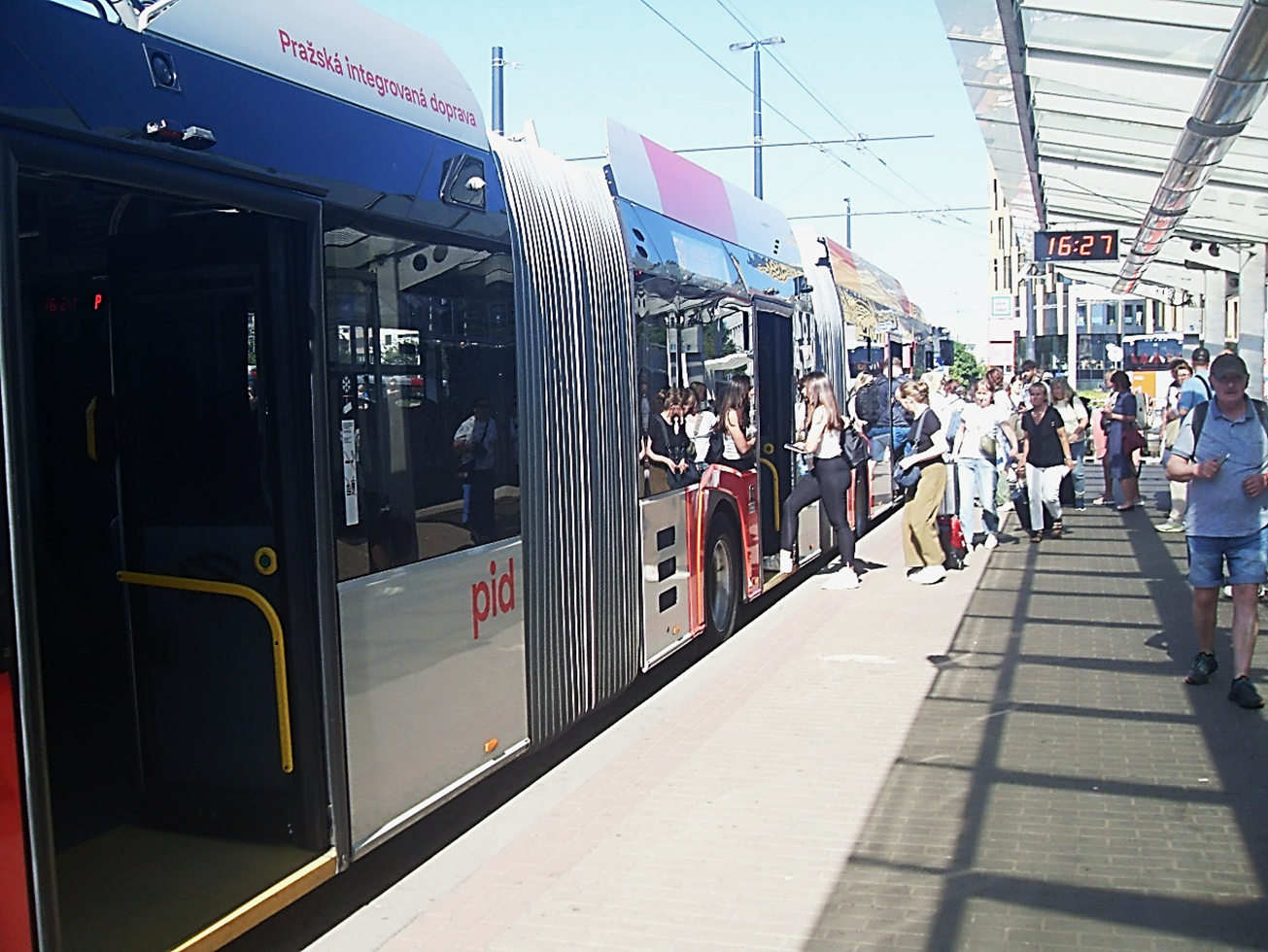 Prague: Nádraží Veleslavín interchange, the final stop of the trolleybus.
The Z-section trolleybus aligns and stands close to the curb of the stop (placing the contact network as close as possible contributes to this). Due to the inclination of the trolleybus body, the entrance to the cabin is as convenient as possible (for wheelchairs, there are folding ramps in the door area). The stop at the beginning of the route (here people get on, not off) is equipped with a canopy, benches, information boards, and timetables. Stops for getting off only do not have canopies and benches (there is no need).
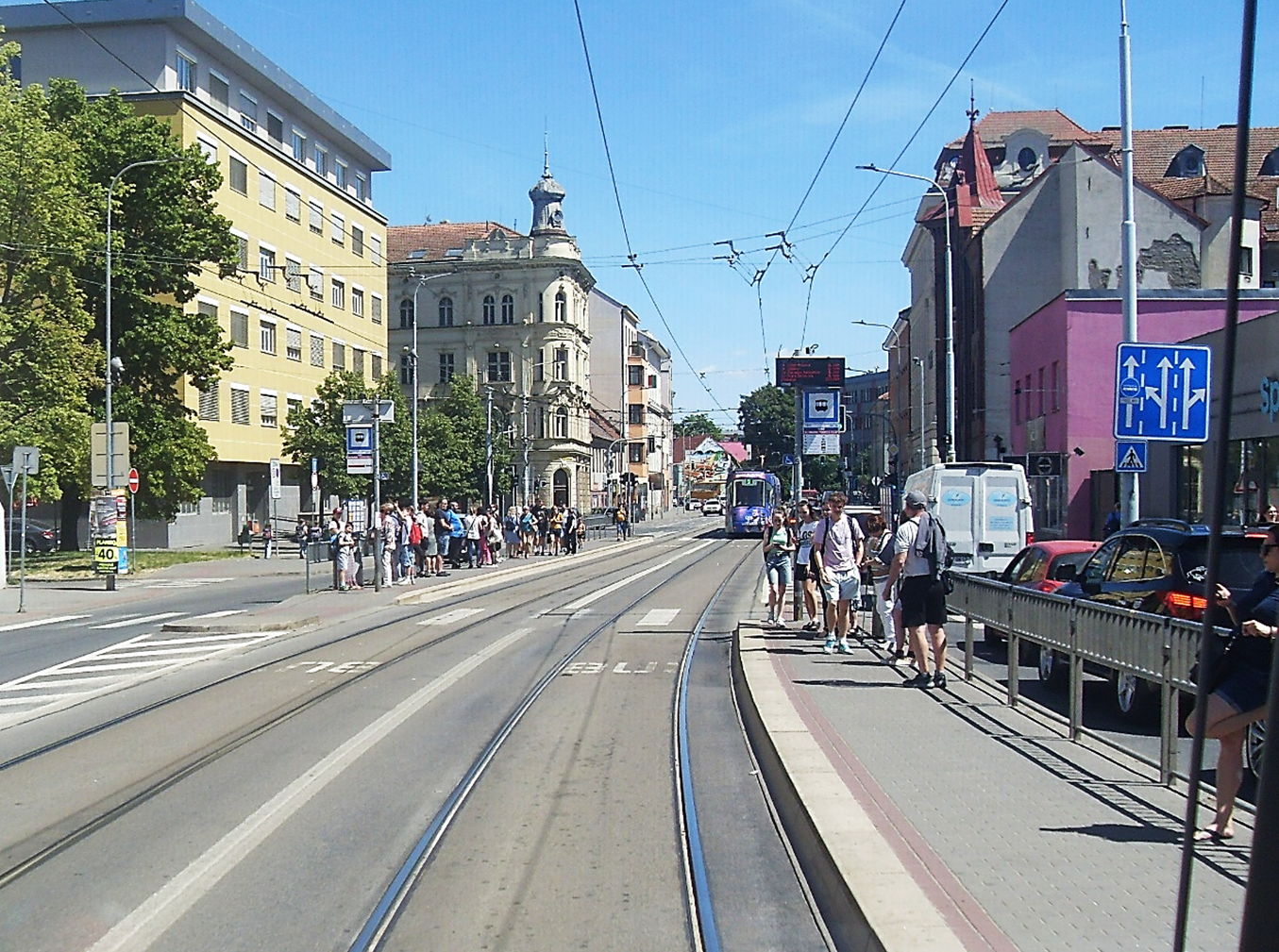 Brno: ul. Křenova, combined tram and trolleybus stop Vlhká.
The trolleybus moves on a dedicated track along the tram tracks. The trolleybus wires are close to the trams and above the landing platform of the stop, and the platform itself, 20 cm high, is located in a curve. A convenient ground crossing between the stops is provided (a stop before crossing in the direction of travel).
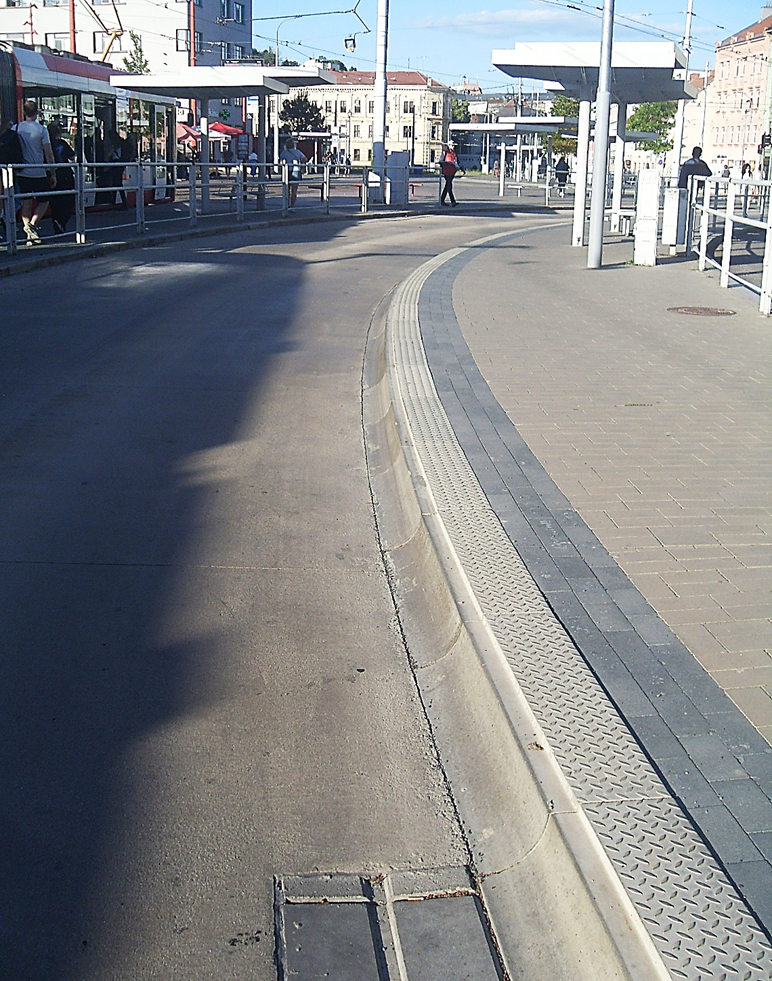 Brno: Mendlovo námestí interchange. The stop's landing area is located in a curve ("convex" towards the trolleybus, which allows the side to be approached close to it). The so-called "Kassel" curb (with a concave side surface) is used, which allows the wheel to be driven over it.
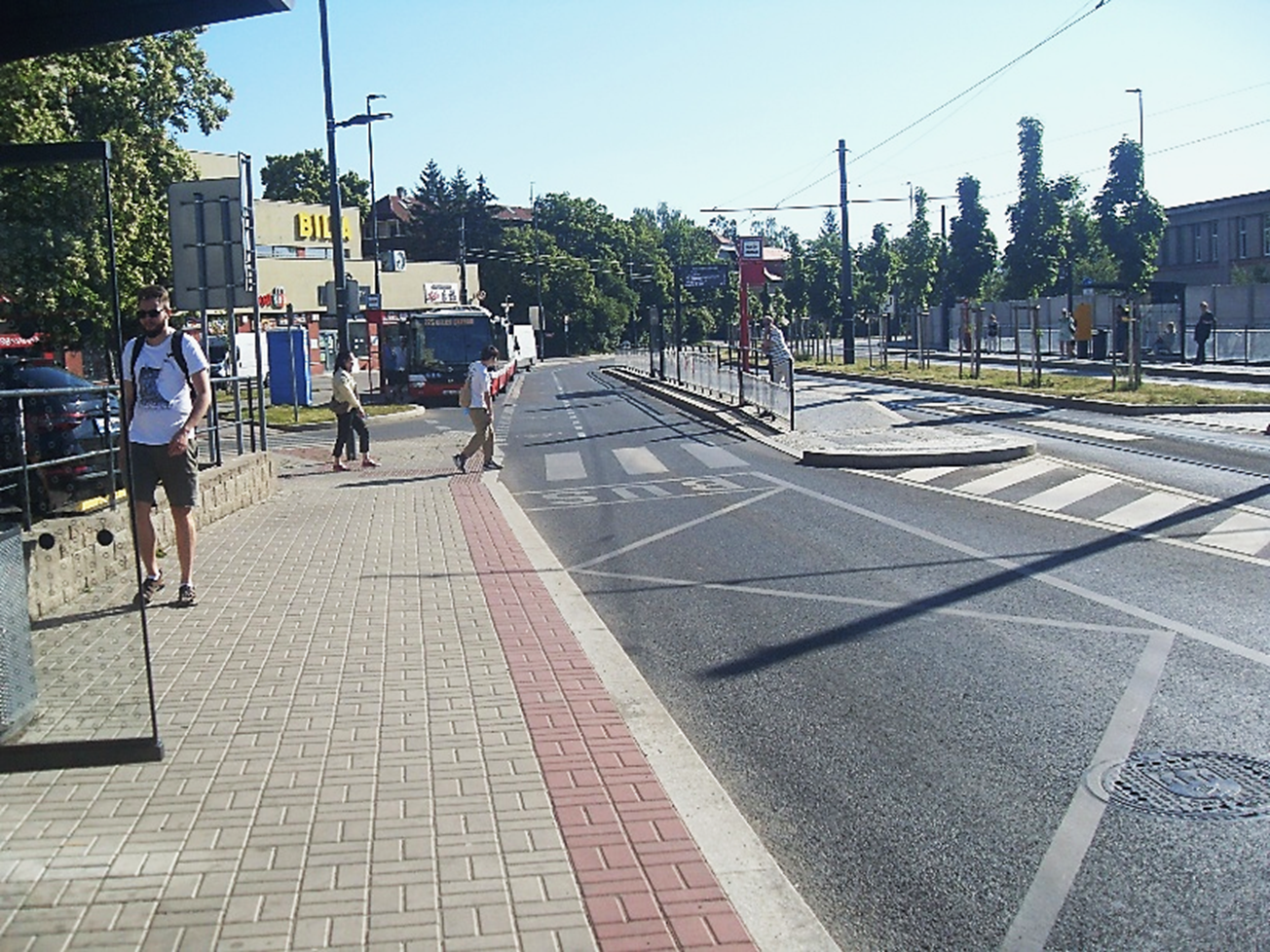 Prague: Sídlište Na Dedine tram and bus stop.
There is no trolleybus traffic here, but the approach to non-rail transport is indicative: there is no pocket at the stop due to the narrow sidewalk, and the bus has priority over the cars behind it, which have to wait until it leaves (there is no room for detours): thus it is emphasized that dozens of bus passengers are more important than a few car drivers behind. This encourages the use of public transport, rather than your own car, which is an “unwanted guest” in the city.
As we can see, in the Czech Republic, when arranging stops, the priority is convenience for the passenger, quick and as close as possible to the curb of the trolleybus (bus), and priority for public transport over private cars.
Space for trolleybus movement: different approaches to solutions
The norms of Ukraine (DBN B.2.2-12 “Planning and development of territories”, DBN V.2.3-5 “Streets and roads of settlements”) provide for the organization of specially allocated lanes for buses and trolleybuses only on main streets, provided that there are 3 lanes in 1 direction (in limited conditions, 2 lanes in 1 direction are allowed). There are no allocated lanes for trolleybuses (buses) on local streets (with 2 lanes in 1 direction or only public transport on the street under limited conditions), trolleybuses in pedestrian zones, or a separate lane (passageway) for non-rail public transport (including those combined with tram tracks). Trolleybus traffic is made dependent on the capacity of streets and roads, even at the cost of route speed and efficiency of its operation (without delays).
In Czech cities, unhindered public transport and strict adherence to schedules are a priority when developing trolleybus and bus infrastructure, even at the cost of comfort for private vehicle users - as at the aforementioned Sídlište Na Dedine stop (previous photo).
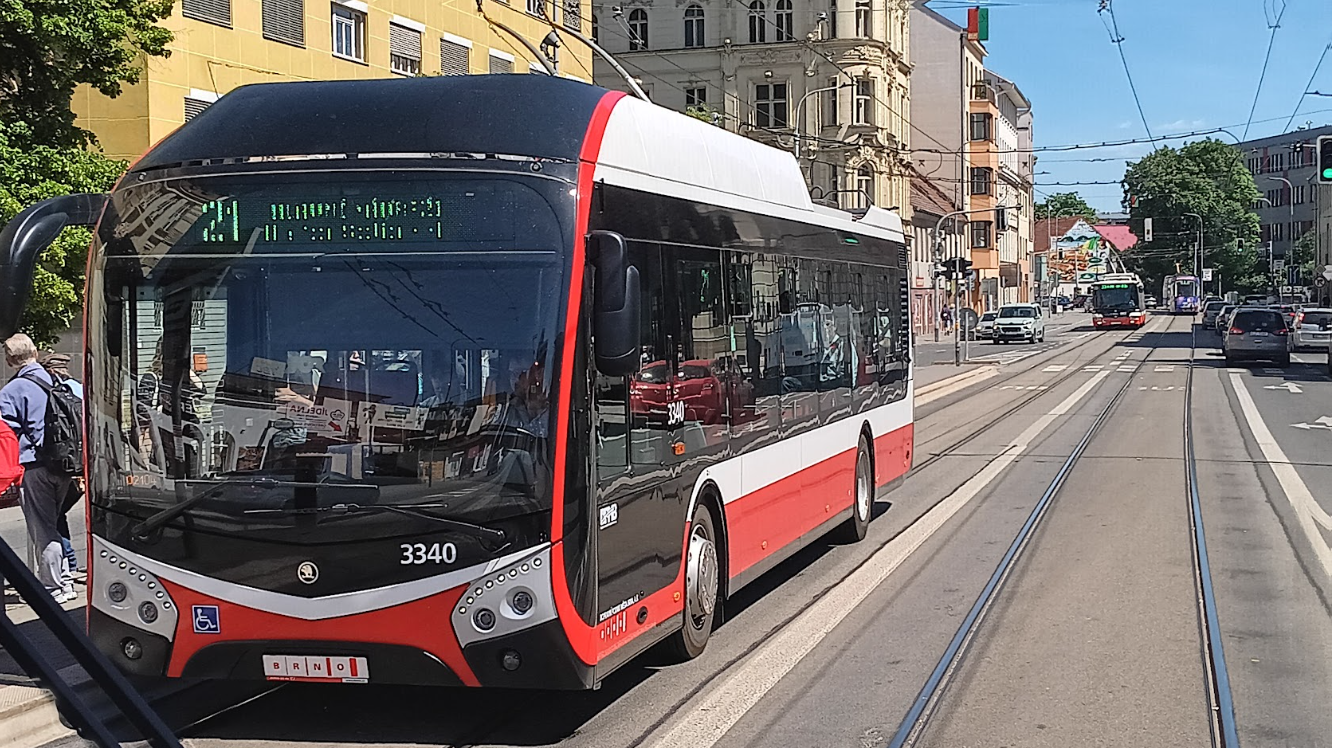 Brno: ul. Křenova, separated tram and trolleybus lanes.
Trolleybus traffic on a narrow street is organized on a separate lane, combined with tram tracks, with shared tram and trolleybus stops, separate from the flow of cars, regardless of traffic jams and the need to leave the stop pocket.
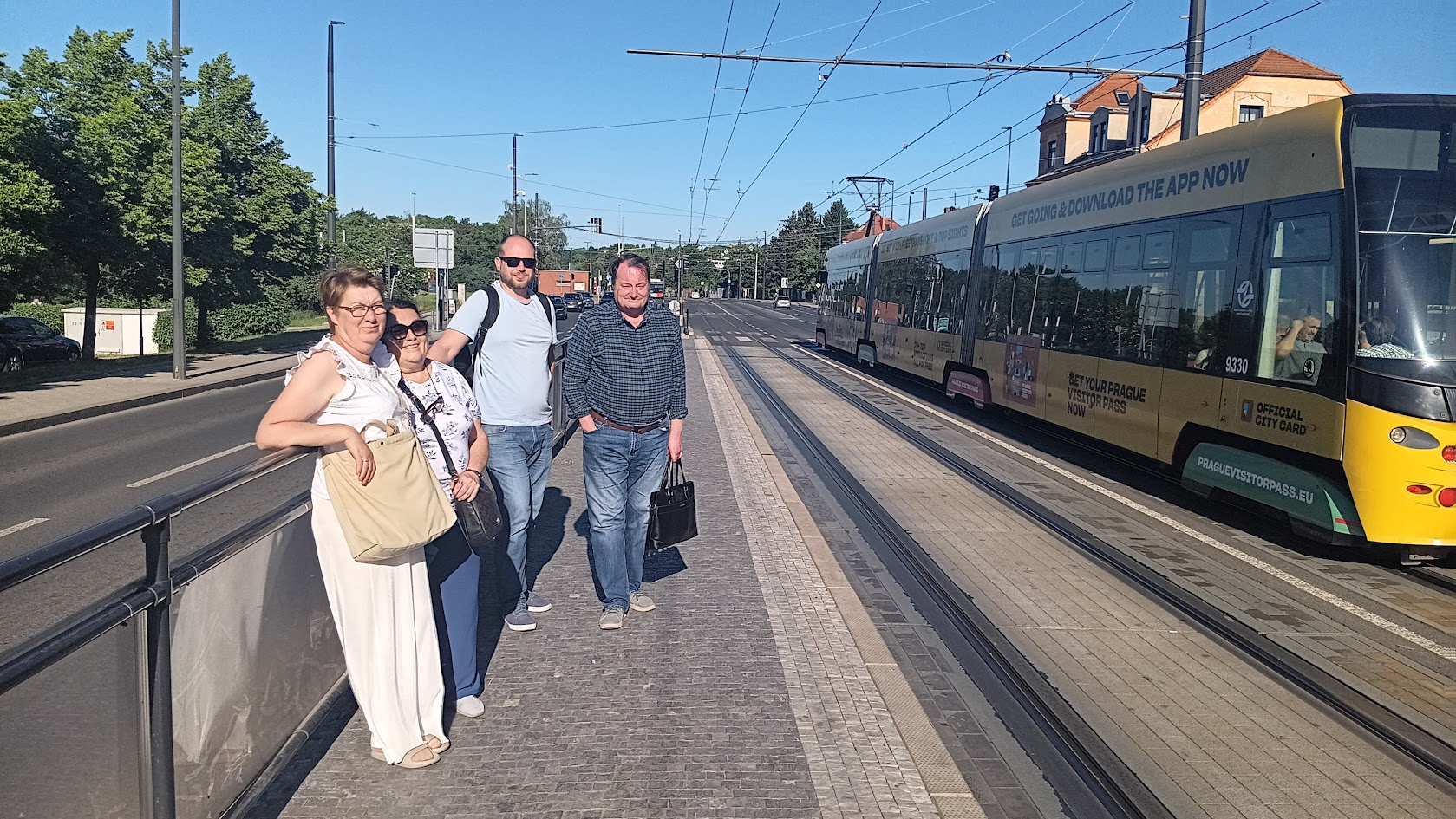 Prague: ul. Evropská, Stop Dívoká Šárka.
Despite the presence of 2 car lanes, the combined bus, trolleybus, and tram stop is arranged separately from the flow of cars. A separate lane for trams and trolleybuses is paved with cobblestones in the stop area.
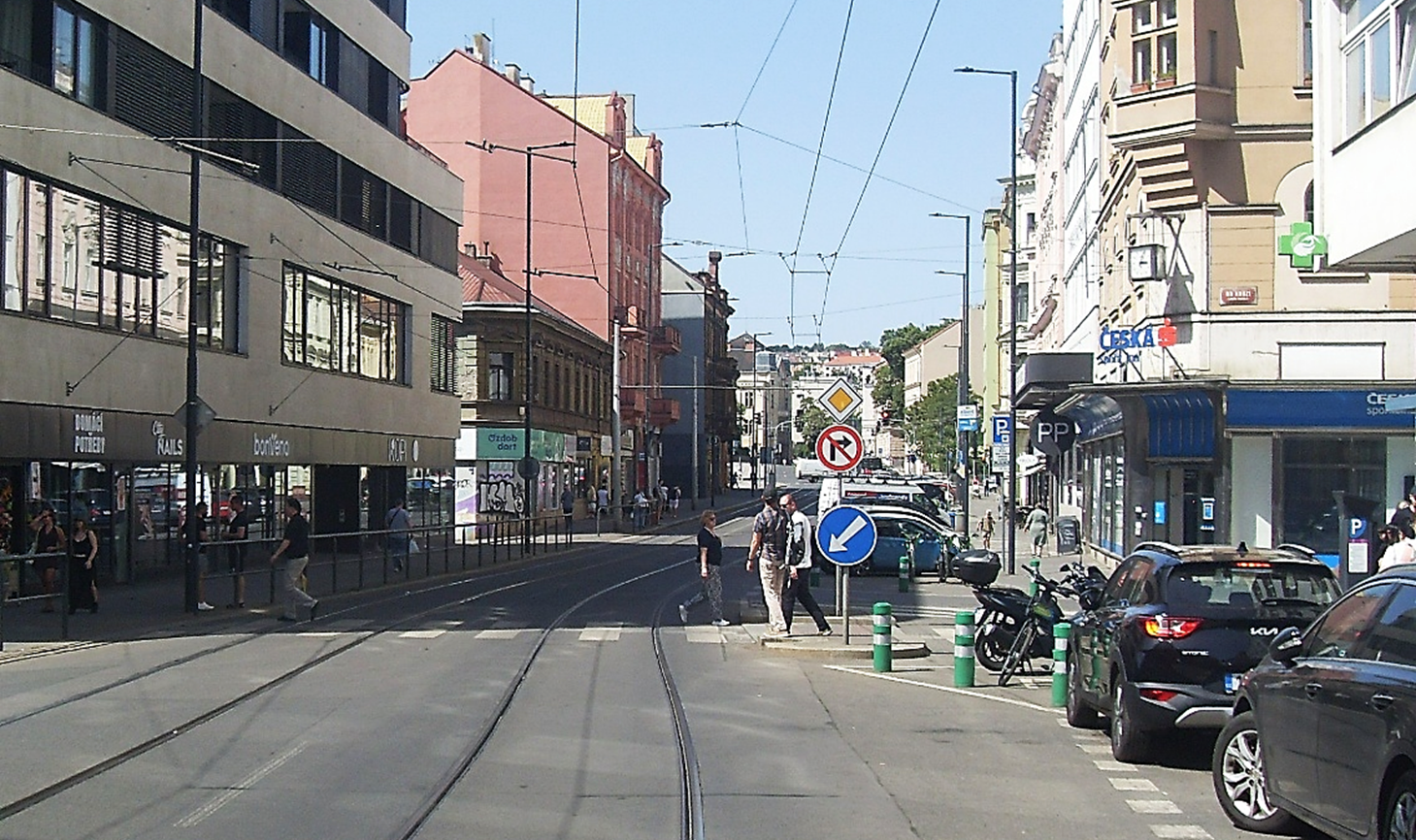 Prague: ul. Zenklova (near the Palmovka metro station)
Trams and trolleybuses operate together on one lane (the lane is also available for private cars). The trolleybus contact network runs above the car park.
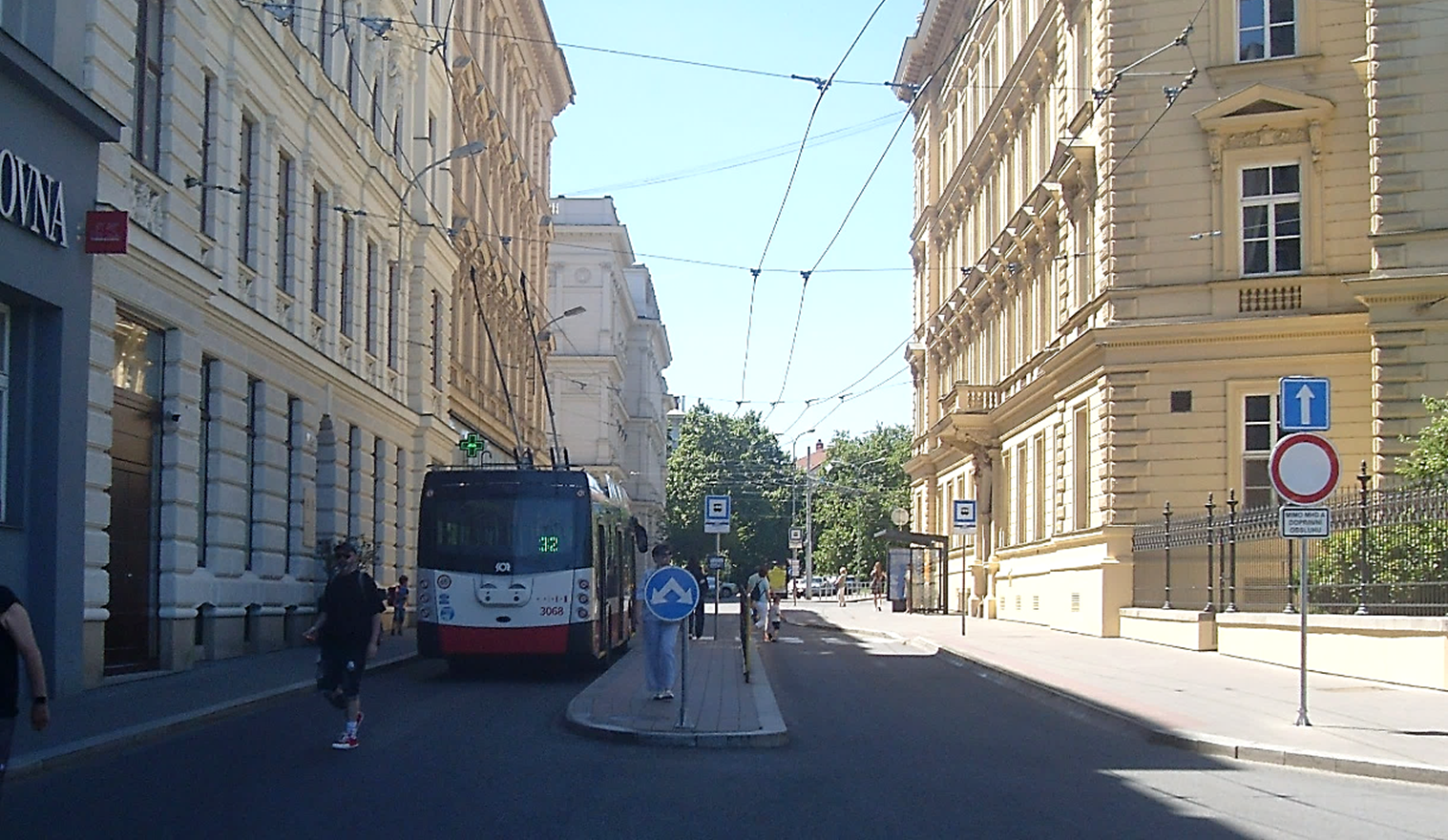 Brno: Trolleybus terminus in the historic center - Česká: 2 landing areas.
To organize the final stop and the trolleybus turnaround, the entire street is closed to private cars and given over to public transport. This allowed two parallel stops to be arranged - so that trolleybuses of different routes do not delay each other, and passengers can board and disembark without crowds.
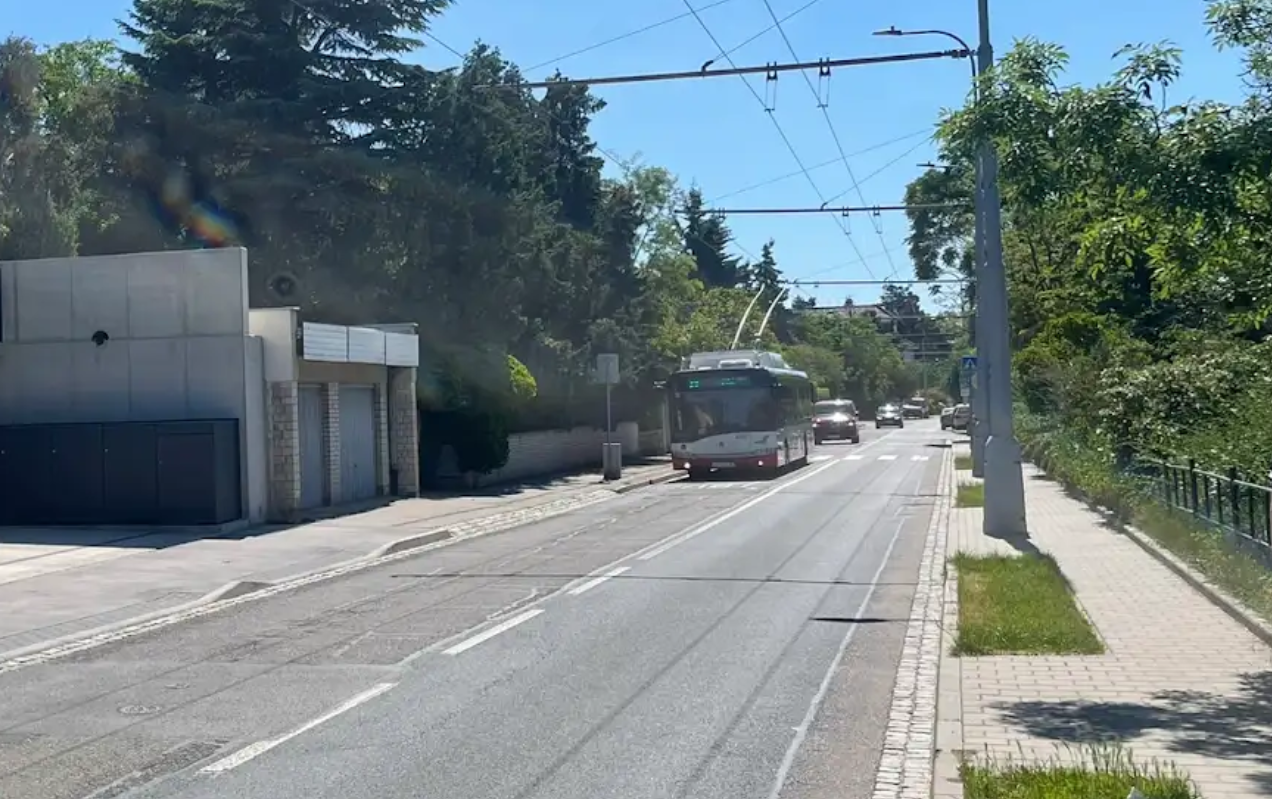 Brno: ul. Preslova. Trolleybus traffic on a residential street. The width of the carriageway is 6.2-6.5 m.
A trolleybus stop on a narrow residential street is organized without a pocket or extensions: other vehicles wait behind the trolleybus until it leaves the stop.
Depot arrangement
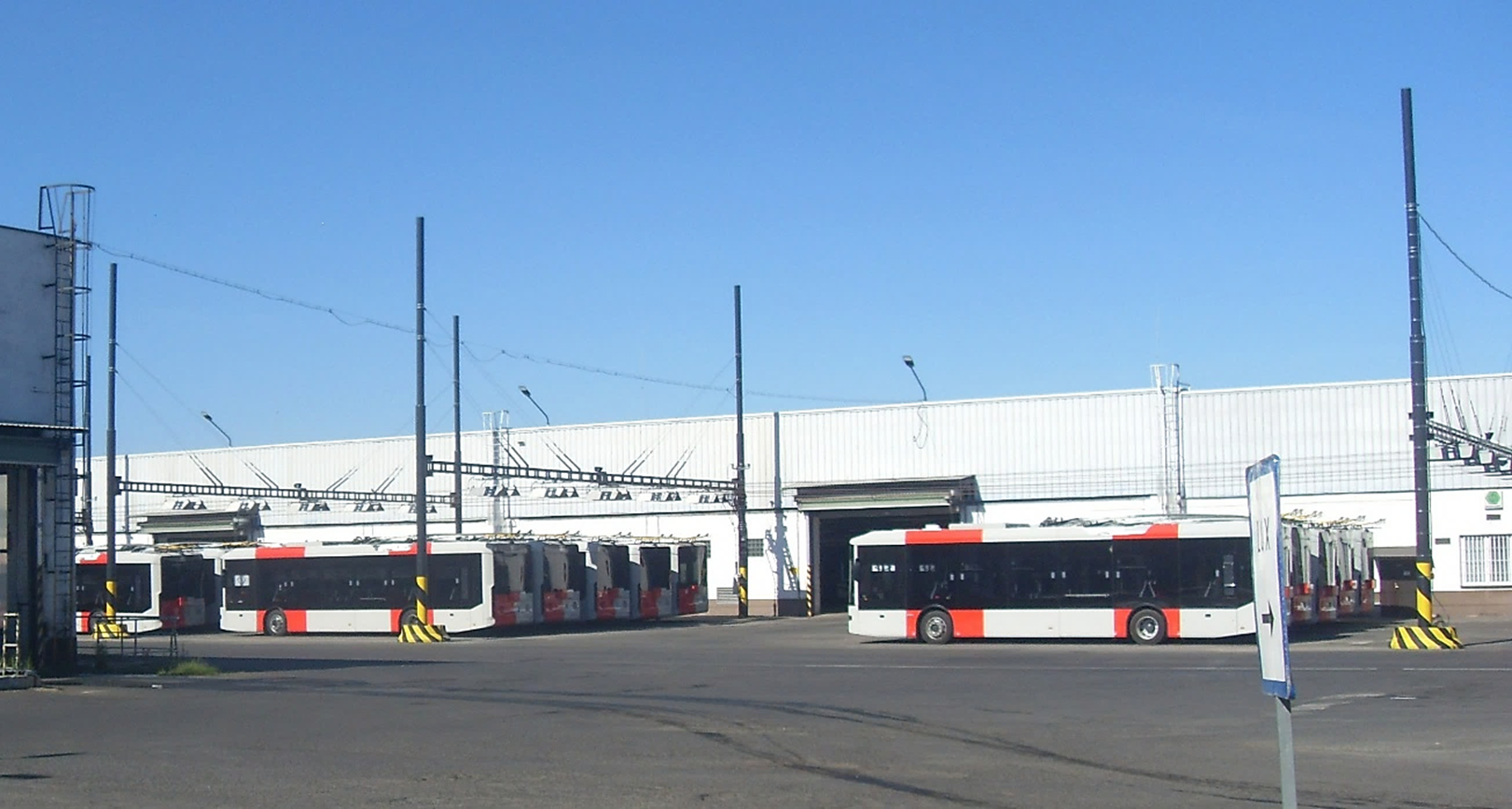 Prague: Řepy bus and trolleybus depot. General view of the park.
The Řepy depot in Prague was previously exclusively for buses. Before the launch of trolleybus traffic on route No. 59 in 2024, the depot was specially reconstructed and retrofitted for the storage, charging and maintenance of battery-powered trolleybuses with ICs.
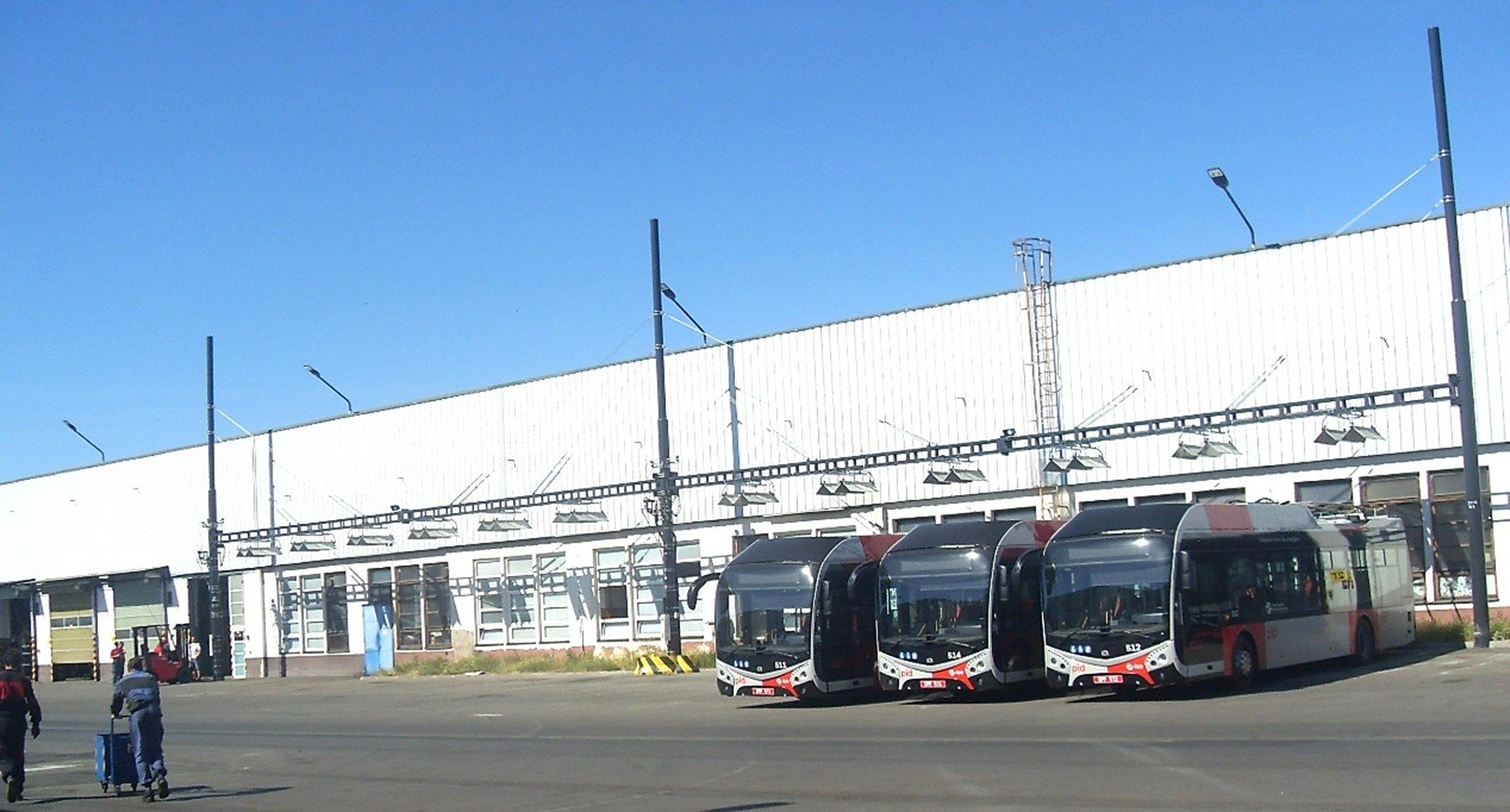 Prague: Řepy bus and trolleybus depot.
Production workshop of the Řepy depot. Places for recharging traction batteries (ACB) of autonomous trolleybuses.
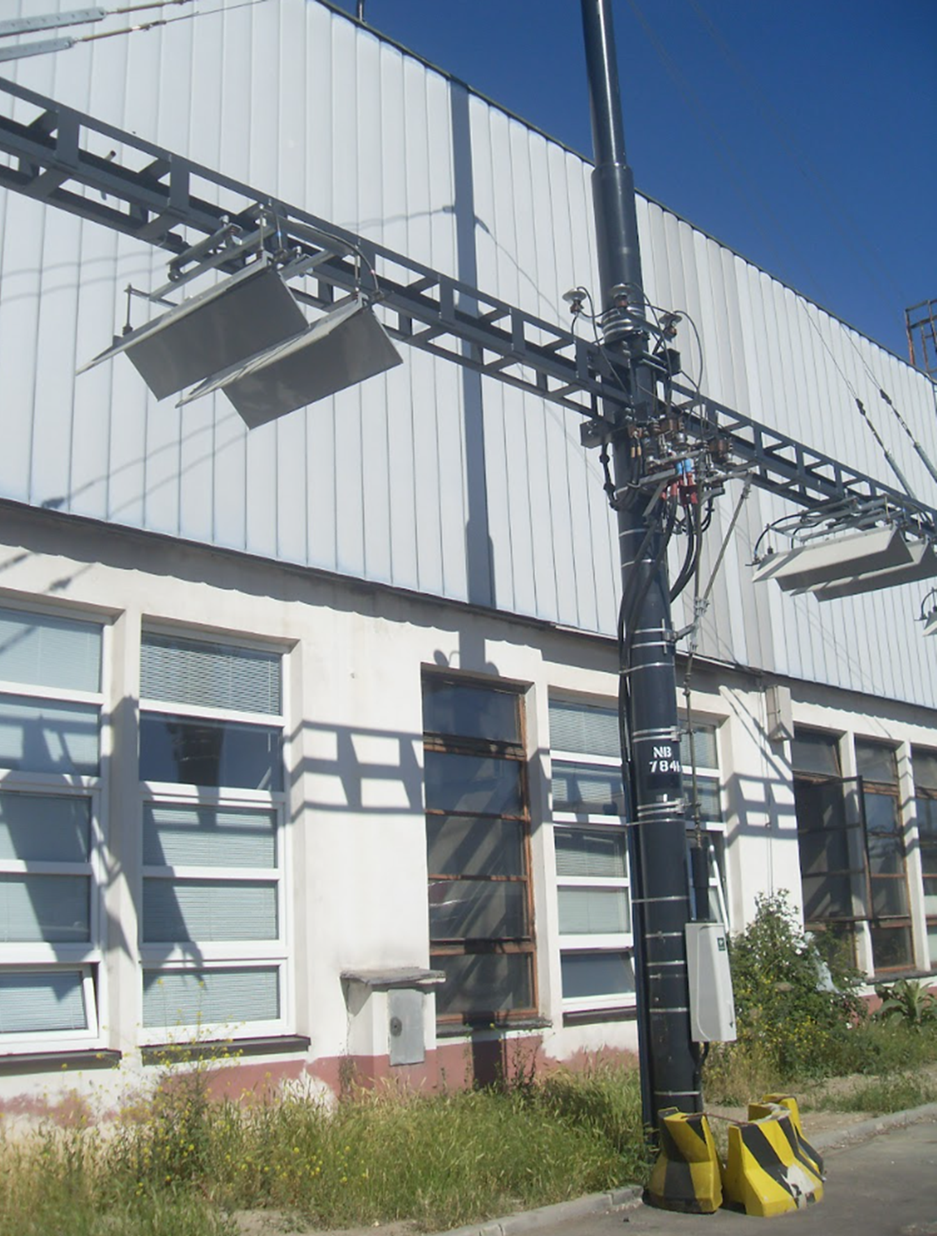 Prague: Řepy bus and trolleybus depot. Night-time charging station for trolleybus batteries.
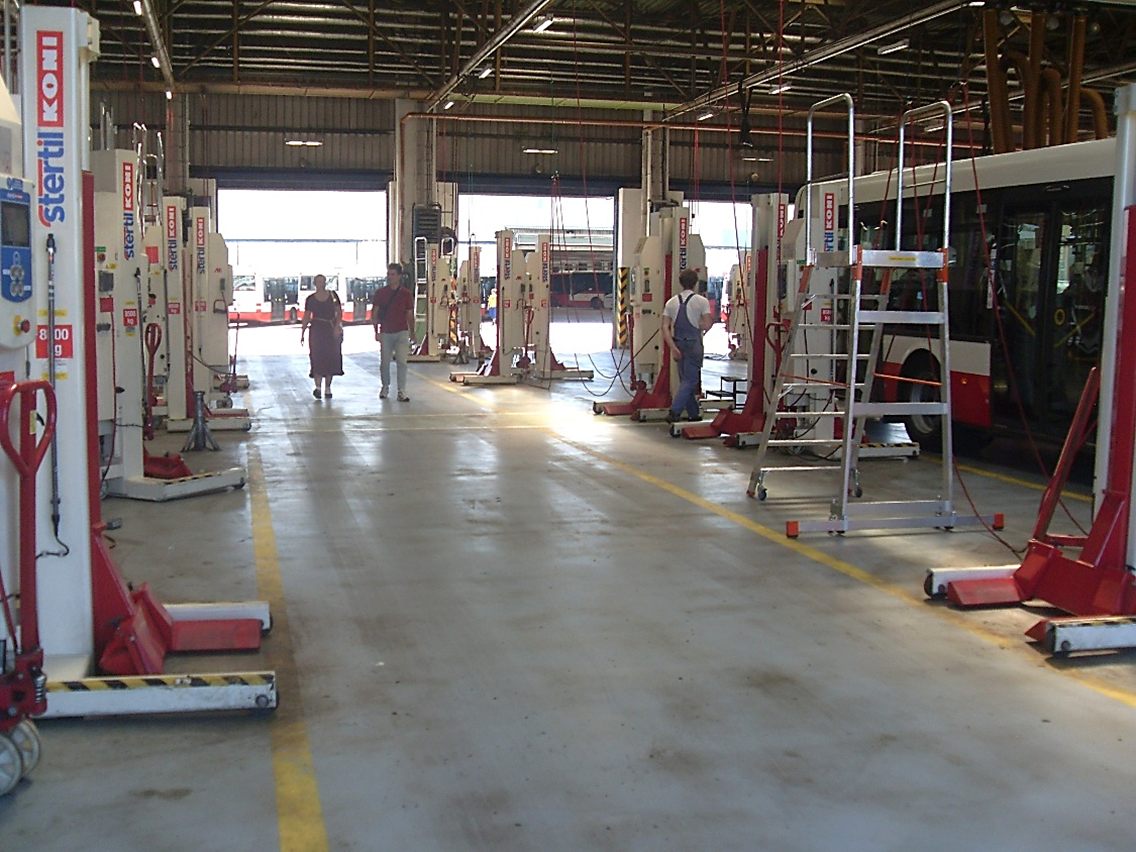 Prague: Řepy bus and trolleybus depot. A staging area for lifting trolleybuses.
Conclusions for Ukraine
A field study of the Czech Republic's practices in the development of trolleybus infrastructure showed that the Czech Republic's norms and practices lack excessive restrictions and prohibitions inherent in Ukrainian norms. The necessary safety requirements are provided by planning and engineering solutions, without the need for excessive investments and without violating the principles of barrier-free access. The knowledge gained and examples of infrastructure in the Czech Republic will be used in the preparation of proposals for the content of the new generation of state building standards of Ukraine, which is being worked on by the public organization "Vision Zero" together with the State Enterprise "Scientific Research and Design and Technological Institute of Urban Economy".
The visit to the Czech Republic took place as part of the project "Removing Obstacles in the Regulatory Framework for the Development of Electric Transport in Ukraine", which is being implemented with the support of the European Climate Foundation in 2025-2026.
Text: Yuriy Lozovenko, Viktor Zagreba
Photo: Anna Atamanchuk, Volodymyr Kryvulya, Viktor Zagreba.