
This publication is a reprint of an analytical article from the Center for Transport Strategies - partners of the NGO “Vision Zero”
How to implement a financing model for urban electric transport in the current conditions of budget deficit and military operations.
In the conditions of a full-scale war that is taking place in Ukraine, transport infrastructure has come under special enemy fire. It is not just about the railways – strikes on trolleybus and tram depots are causing significant damage to urban transport fleets and are jeopardizing the development of sustainable urban mobility. To ensure that this trend continues, cities are trying to fill their streets with new vehicles on their own.
A significant part of the city's transport fleet has now been replaced by used but well-maintained equipment donated by municipalities in Germany, Poland, Switzerland, the Czech Republic, Latvia and other countries. Ukraine also attracts significant funds from the European Investment Bank (EIB) and the European Bank for Reconstruction and Development (EBRD). Due to constant shelling of energy infrastructure and electricity shortages, cities are purchasing or independently modernizing trolleybuses with diesel generator sets or large-capacity batteries for autonomous operation. All this requires additional costs.
So, what should be the financing model for urban electric transport in conditions of acute budget deficit and military operations?
There are legal regulations, but it's more complicated with money...
Urban transport is not in the best condition, the Ministry of Reconstruction, Infrastructure and Transport states. They talk about the great wear and tear of the infrastructure, the rolling stock itself and the high motorization of the population. At the same time, the development of urban electric transport is among the priorities of the ministry.
In order to help cities cope with the consequences of shelling and damage to a large number of rolling stock, the ministry developed, and the Verkhovna Rada adopted, Law No. 4397 on Amendments to Meeting the Population's Transportation Needs under Martial Law. This enabled public transport enterprises to use equipment received as humanitarian aid. According to the representative of the relevant ministry, Tetyana Navrotskaya , currently the number of such transport in Ukraine exceeds a thousand units. But this is a short-term perspective, she emphasizes. The law will cease to apply 12 months after the end of martial law.
At the same time, the Cabinet of Ministers approved Resolution No. 1739, which regulated the issues of registration, accounting and state technical inspection of trams and trolleybuses, developed by the State Transport Safety Service. It defines a clear procedure for registration and re-registration of tram cars and trolleybuses, and maintaining their state accounting. The procedure for mandatory annual technical inspection of urban electric transport rolling stock, as well as infrastructure - tracks, contact networks, traction substations, has been established. This resolution also introduced simplification of procedures through their digitalization. Urban electric transport enterprises, as the government emphasizes, have the opportunity to submit documents for registration and accounting in electronic form with the provision of copies of the necessary technical and legal documents.
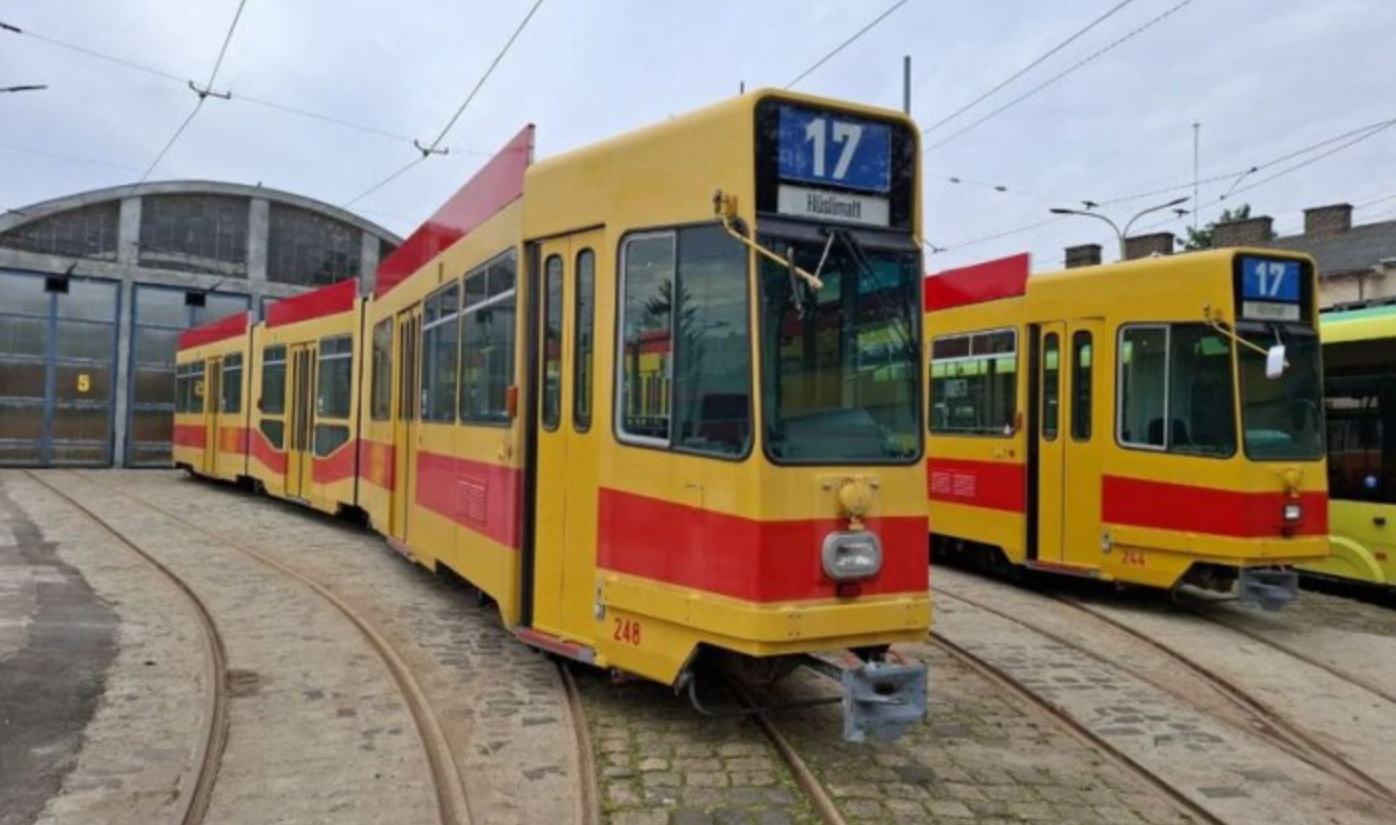
Used electric vehicles from Europe help Ukrainian cities overcome the shortage of rolling stock in the current conditions
"Urban transport is not just about purchasing new cars," emphasized Tetyana Navrotska during the Urban Mobility Forum 2016. "We also have to think about what the infrastructure will be like for them. Will there be charging stations for electric buses? How will autonomous trolleybuses move?"
The modernization of public transport is inevitable, but expensive. The state decided to approach this issue by developing a transport portfolio package for the program "Development of local electric transport and infrastructure". It provides for the overhaul of tram and trolleybus tracks, contact network and traction substation equipment. In terms of fleet modernization, the focus is on the purchase of modern rolling stock (trolleybuses, trams, electric buses), which reduce the burden on the environment and improve the quality of transportation. It is proposed to integrate municipal electric transport development projects into the general system of renewal of Ukrainian cities through state and international platforms, such as DREAM.
The cost of this project for urban transport, according to Navrotskaya, reaches 486 billion UAH. "This is a very large amount, which includes not only the purchase of new transport, but also the renewal of the entire infrastructure, the construction of new routes," she says. "Only for the renewal of trams under this program, 134 billion UAH should be allocated." Among the minuses - the source of financing for this program has not yet been determined. But the government plans that it will be carried out both at the expense of the state and at the expense of international partners.
In the perspective of implementing this program, special emphasis is placed on local manufacturers. According to expert assessments of international partners, Ukraine currently has a very attractive investment potential in terms of developing domestic transport engineering, says Tetyana Navrotskaya. But she also notes: "There is a lack of funds." She said that a lot has been done in this area under the international assistance projects Urban and Public Transport I and II, which were implemented jointly with the European Investment Bank. However, if contracts for 119 million euros were concluded within the framework of the first package, and 60% of them were used, then in the second - contracts for 38 million euros were concluded, and this was only 37% of what was allocated to us by the EIB. "Although the funds under the first two programs were not used in full," Navrotskaya states. - The Ministry supports such an initiative and has now begun preparatory work for the implementation of the project jointly with the EIB "Urban Public Transport III."

One of the examples of the work of the "Urban Public Transport of Ukraine" program is the receipt of 9 trolleybuses with autonomous operation by the city of Fvano-Frankivsk.
In search of new financial instruments
Today, you can hear a lot about the fact that, on the one hand, cities are in critical need of transport infrastructure and the restoration of rolling stock. On the other hand, we have enough of our own production capacities to cover these needs. "The question arises: where is the problem?", - emphasizes Olena Chernyshova, who represents the International Finance Corporation (IFC) .
According to the expert, the answer is that the financing instruments currently available in Ukrainian cities are insufficient. This is precisely what prevents us from solving the problem and combining demand with supply.
"We don't talk much about the fact that even before the full-scale invasion, we were already faced with the problem of the critical state of the infrastructure and the high level of wear and tear of rolling stock," she says. "The war only spread this problem. On the one hand, more than 70% of the rolling stock in our cities has been in operation for 15 years. On the other hand, a significant part of the renewal is again due to used transport and the continued use of technologies that do not meet the requirements of modernity."
Communities currently face severe budget constraints and are often unable to finance large-scale rolling stock upgrades. Private carriers, on the other hand, lack access to financing and lack the motivation and incentives to invest in rolling stock.
According to World Bank estimates, subject to the implementation of necessary reforms and alternative financing models, the investment potential in the urban mobility sector in Ukraine is over $15 billion. “This issue is especially relevant in the context of electric transport, low-carbon transport, if we are talking about the transition to new technologies at the same time,” Chernyshova notes.
What is holding back financing for the renewal of Ukraine's rolling stock today? Many municipal enterprises, communities, and private carriers have low solvency and, accordingly, have difficulties in attracting financing. After all, it is a matter of a large amount of initial investment. When it comes to rolling stock, it is expensive and this is something that must be spent first, and only then gives a result. "The small size of projects," emphasizes the IFC representative. "This is relevant for medium and small communities. Combining projects is one of the tools."
Another possible tool is to increase the tariff. But this issue is politically sensitive and creates unpredictability of cash flows. Such projects are quite difficult to implement.
"In fact, there is no systematic approach in the country and the carrier and communities are left alone to solve the problems of rolling stock. And everyone solves their problem as they know how," Chernyshova notes.
Based on global experience, she says that before moving on to a large-scale renewal of rolling stock, it is necessary to solve problems in four key areas - strengthening institutional capacity, improving contracts between the regulator and carriers, effectively distributing risks between the public and private sectors, and introducing new financial instruments.
One of such constructive solutions that IFC is testing and implementing in Latin American and Asian countries is the creation of specialized transport asset management companies based on the AssetCo principle. This is a model in which a company specially created for asset management raises financing, purchases transport directly from manufacturers and, while retaining ownership, provides it to carriers under rental, financial or operating lease terms. Carriers, for their part, can focus on providing quality services. And the community or state acts as a regulator. This model allows attracting private capital, combining the needs of several cities and communities under unified technical requirements and significantly reducing the financial burden on individual carriers.
"We have experience in Latin America," said Olena Chernyshova. "In 2024, IFC supported the implementation of such a model in Santiago, Chile, by attracting over $340 million to create such a company to supply buses. It purchased almost a thousand electric buses from the manufacturer and transferred them to the carrier. At the same time, the municipality of Santiago held a tender for transportation and entered into leasing agreements for the transfer of rolling stock. This increased their reliability, because in this case, a transportation process is formed without the risk of losing rolling stock if a carrier does not go on the line. The carrier provides transportation and maintenance under the terms of leasing agreements."
This example demonstrates that the conditions under which ownership and management of rolling stock is separated allow for greater investment from banks and international financial institutions and increases the scale of rolling stock renewal programs.
But in addition to the model already mentioned, IFC advises paying special attention to supporting reforms to remove barriers to cooperation with international institutions. It also recommends paying attention to the process of preparing projects and structuring commercial models, preparing concession agreements for public-private partnerships, and supporting mechanisms that help make the project attractive for investment.
According to Olena Chernyshova, IFC is currently working on developing a project viability gap fund. It allows attracting financing to projects that are not commercially attractive in themselves. This model will be tested in Lviv, in the healthcare sector. And in the future, it can be applied in the transport sector.
Kyiv transport analyst Oleksandr Grechko believes that within the framework of the budget deficit, priority attention should be paid to rolling stock, which can be given to us inexpensively or for free. Donor funds or loans should be directed to new rolling stock.
"Attracting private funds to the purchase of public transport is a good option. In particular, in Chernihiv in 2023, the city guaranteed private carriers income for the work performed, regardless of the number of passengers transported. At the same time, they were recommended to maintain a certain fixed tariff and update the rolling stock. And in accordance with the updated stock, service tariffs were established. Cities can create conditions for private carriers to modernize rolling stock so that passengers receive better services," Grechko explains.

Thanks to IFC financing, Santiago, Chile, has the world’s largest fleet of electric buses outside of China
Create your own mobility system
The requirements of the European Union, which generally relate to transport logistics, are very serious for our country, notes Oksana Savchuk, a representative of the Verkhovna Rada Committee on Transport and Infrastructure .
According to her, our country must move to a unified mobility system that involves Ukrzaliznytsia, road transport, and urban electric transport. "We cannot move away from the fact that we need to take into account a new type of logistics through UZ and "ring-fence" the system," she says.
At the same time, according to the MP, we have a unique chance to create our own mobility system in the state. After all, we can take as examples the models according to which transport services are provided in Vienna or London, but these cities do not have the challenges that Ukraine has today. "We must take into account the presence of video cameras and smart traffic lights, but we must also take into account the presence of a real resource in the state, as well as access to shelters. We have new challenges," the MP summarizes.

Mobile shelter at a trolleybus stop in Dnipro
One of the practical steps in this direction is that in September, Kyivpastrans announced that the company plans to purchase and install 14 primary mobile shelters. Some of them will be placed on the territory of branches and separate divisions of the company, and some - at ground public transport stops, where the need for such structures will be identified as a priority.
Oleksandr Grechko agrees that in our conditions, when we have to deal with attacks on both the energy sector and gas stations at the same time, it is difficult to find something that would be completely independent of security factors. But we can single out types of transport that will be resistant to such situations.
"If we talk about the greatest maneuverability, these can be buses. Diesel or gas-powered - those that are not tied to the contact network, and which have a good range without any recharges. They have a significant mileage. And when they are in sufficient reserve and there is a sufficient reserve of drivers, they can be transferred to trolleybus routes. Or, as in the case of Kyiv, try to compensate for the lack of a metro on the ground part of the red branch, - explains the expert. - In certain cases, you may have to deal with damage to the trolleybus network. Therefore, cities should take care of purchasing trolleybuses that have a sufficient reserve of autonomous travel. So that they can pass the destroyed section without hindrance. They are more mobile and for ordinary cases when there was an accident somewhere and it needs to be bypassed, or parked cars have blocked the road."
At the same time, for cities that do not have a trolleybus network, purchasing electric buses is a good option. "This is a European trend. But you need to understand: if there is a contact network, it is better to buy trolleybuses with sufficient autonomous travel so as not to spend money on developing the contact network. Then you will not have to equip additional infrastructure for charging electric buses," Oleksandr Grechko summarizes.
This publication is a reprint of an analytical article from the Center for Transport Strategies - partners of the NGO “Vision Zero”